

Are you planning a road trip in your RV and wondering how to keep your battery charged? You’re not alone. Many RV enthusiasts face the challenge of maintaining power while off the grid. Knowing how many watts you need from solar panels can make all the difference in your adventures.
Key Takeaways
- Understand Battery Types: Familiarize yourself with the two common RV battery types, lead-acid and lithium, to determine appropriate solar charging needs effectively.
- Charging Requirements Vary: Lead-acid batteries generally need about 100 watts for a 100Ah battery, while lithium batteries require 50-70 watts for the same capacity due to their efficiency.
- Account for Power Needs: Calculate your daily energy consumption in watts to determine how much solar power is necessary to meet your RV’s requirements.
- Estimate Solar Production: Assess average daily solar panel output by multiplying panel wattage by sunlight hours, ensuring your energy needs align with production capacity.
- Follow Wattage Recommendations: Start with at least 100 watts for basic charging, and consider 200-600 watts for more demanding energy needs based on battery capacity and appliance usage.
- Plan for Variability: Always account for factors like weather and shading that can affect solar performance, ensuring you have extra capacity to maintain a steady power supply during your RV adventures.
Understanding RV Battery Types
Understanding the types of RV batteries helps you determine the right solar setup to keep your power supply reliable. Two common battery types are lead-acid and lithium. Each type has unique characteristics that influence charging requirements and overall performance.
Lead-Acid Batteries
Lead-acid batteries are traditional and widely used in RVs. They come in two main types: flooded and sealed. Flooded batteries require maintenance, including regular water checks. Sealed batteries, like AGM, need less attention but often cost more.
When considering solar charging, remember that lead-acid batteries should not discharge beyond 50% of their capacity to ensure a long lifespan. Charging these batteries typically requires about 10% of their capacity in watts for optimal performance. For example, a 100Ah lead-acid battery should receive around 100 watts of solar power to maintain charge effectively.
Lithium Batteries
Lithium batteries are newer, lighter, and offer higher energy density than lead-acid options. They recharge faster and can discharge up to 80-90% of their capacity without damage. This feature makes them particularly appealing for RVs that need consistent power.
When charging with solar, lithium batteries generally require less wattage than lead-acid batteries due to their efficiency. A 100Ah lithium battery often requires about 50-70 watts of solar power. Their ability to recharge quickly allows for better adaptability while on the road, as you benefit from shorter charging times.
Understanding these battery types helps you choose the right solar panel wattage. Consider your power needs, battery type, and solar panel output to ensure a smooth RV experience.
Factors Affecting Solar Power Needs
Several factors influence the solar power requirements for charging your RV battery. Understanding these elements helps ensure you select the right solar panel system for your needs.
Battery Capacity
Battery capacity plays a significant role in your solar power needs. Capacity is measured in amp-hours (Ah) or watt-hours (Wh). Larger batteries store more energy, requiring more solar watts for a full charge. For example, a 200Ah lead-acid battery needs around 2000 watt-hours to fully charge. In contrast, lithium batteries have higher energy density and faster charging times, so these may require fewer solar watts. It’s important to consider your battery capacity when estimating solar requirements.
Daily Energy Consumption
Daily energy consumption dictates how much solar power you need. You first calculate your daily usage in watts or watt-hours, then compare it to your solar panel output. For instance, if your RV appliances consume 600 watts each day, you’ll need enough solar panels to produce that amount, factoring in sunlight availability. If a solar panel generates 100 watts under optimal conditions, you’ll need at least six hours of sunlight to meet your needs. Remember, factors like weather and shading can impact performance, so it’s wise to plan for extra capacity.
Calculating Solar Power Requirements
Understanding how to calculate your solar power requirements ensures you’re prepared for all your RV adventures. Here’s how to determine your needs effectively.
Recommended Products
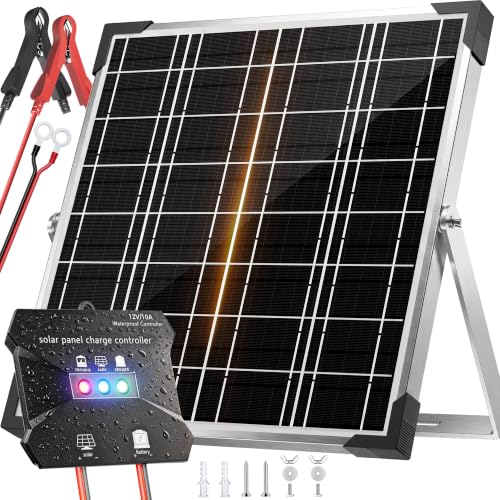
High-Efficiency MPPT Solar Charger - Advanced tracking technology delivers 20-30% faster charging for 12V batteries. A+ monocrystalline panels maximize power conversion. Perfect 20W solar trickle charger for cars, RVs, boats, and trailers. More sun captured, less time waiting.

【High Conversion Rate】This 20W solar panel with monocrystalline A+ solar cell has an excellent cell efficiency of 21%-30%. Designed to charge and maintain 12V rechargeable batteries like LiFePO₄, Lithium Ion, AGM, SLA, GEL, EFB, MF, etc. Keep batteries in charged for trailer, tractor, truck, boat, motorcycle, RV, car, lawn mower, water pump, gate opener, electric fence, etc

✔️【Waterproof Solar Charge Controller】IP67 waterproof, suitable for outdoor use. Automatically identify voltage, 12V Max power: 150W, 24V Max power: 300W. The maximum current is 10A. Compatible with various 12V/24V deep-cycle batteries, such as AGM, GEL, Flooded. Adopting brand MCU chips to realize fast intelligent control and ultra-low standby power consumption.
Determining Battery Amp-Hours
First, figure out the total amp-hours (Ah) your battery system requires. Amp-hours represent the energy a battery can deliver over time. For instance, if you use a 12V battery, you can calculate the amp-hours using this formula:
[ \text{Watt-hours (Wh)} = \text{Voltage (V)} \times \text{Amp-hours (Ah)} ]
If you have a 100Ah battery, you possess 1200 Wh (12V x 100Ah). Factor in your battery type; lead-acid batteries shouldn’t discharge beyond 50% for long life, while lithium batteries can safely discharge 80-90%.
Estimating Daily Solar Production
Next, estimate how much solar power you produce daily. Average output varies based on panel quality, sunlight hours, and location. Here’s a simple way to estimate:
- Identify Solar Panel Wattage: Check the wattage of your solar panels. For example, a 100W panel produces about 100W in ideal conditions.
- Calculate Daily Production: Multiply the panel wattage by average sunlight hours. If you have one 100W panel and receive about 5 sunlight hours daily, your calculation is:
[ \text{Daily Production (Wh)} = \text{Panel Wattage (W)} \times \text{Sunlight Hours} ]
So, it’s (100W \times 5 \text{ hours} = 500Wh).
- Compare Needs vs. Production: Finally, compare your total daily energy usage with your daily solar production. Ensure your panels cover your RV’s power needs, accounting for weather impacts or shading.
By following these guidelines, you can confidently assess how many watts of solar power you’ll need to charge your RV battery effectively.
Recommended Wattage for Charging RV Batteries
Understanding the recommended wattage for charging RV batteries is crucial for optimizing your solar power setup. Here’s how to determine the right wattage for your needs.
Recommended Products

50W Power That Maintains Your Battery: High-efficiency 50 watt solar panel / 50w solar panel delivers steady output even in low light. A true 12v solar battery charger that outperforms smaller panels and keeps car, RV, boat batteries alive longer.
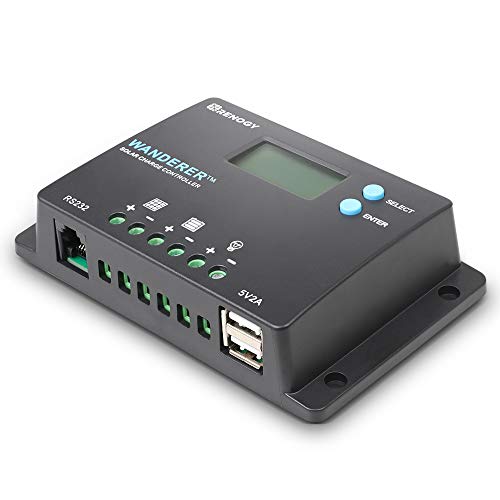
𝐒𝐦𝐚𝐫𝐭 𝟒-𝐒𝐭𝐚𝐠𝐞 12V/24V Solar Charge Controller: Renogy charge controller 𝐦𝐚𝐱𝐢𝐦𝐢𝐳𝐞𝐬 𝐁𝐚𝐭𝐭𝐞𝐫𝐲 𝐋𝐢𝐟𝐞 & 𝐒𝐨𝐥𝐚𝐫 𝐄𝐟𝐟𝐢𝐜𝐢𝐞𝐧𝐜𝐲, this advanced pwm solar charge controller utilizes intelligent 4-stage charging (Bulk/Boost/ Float/Equalization) to optimize power delivery for AGM, Gel, Flooded and Lithium batteries. RV solar charge controller prevents overcharging and gas buildup while 𝐚𝐜𝐡𝐢𝐞𝐯𝐢𝐧𝐠 𝟑𝟎% 𝐥𝐨𝐧𝐠𝐞𝐫 𝐛𝐚𝐭𝐭𝐞𝐫𝐲 𝐥𝐢𝐟𝐞𝐬𝐩𝐚𝐧 compared to basic charge controllers.

【COMPACT & TRAVEL-READY】 Folds down to 19.3x20.9x1.1in and just 7.3lb—light enough to pack, carry, and set up solo. Perfect for RVs, vans, camping, or backup power.
Minimum Wattage Recommendations
You should consider a minimum of 100 watts of solar power for basic battery charging on an RV. This wattage typically suffices for smaller systems or for occasional trips. For example, this will adequately power a 100Ah lead-acid battery to maintain its charge during weekends or short outings.
If you use more appliances or electronics, bumping up to 200 watts is advisable. This level effectively supports common energy consumers like refrigerators and lights, providing a more reliable power supply.
Optimal Wattage for Efficiency
For optimal efficiency, aim for at least 300 watts of solar power for larger RV battery systems. This wattage suits a 200Ah lithium battery, enabling quick and effective charging even during cloudy days.
Incorporating this additional wattage means you can comfortably use more energy-intensive devices, thus enhancing your overall camping experience. Consider that solar panels rated at this capacity can produce 1,500 watt-hours per day with five hours of sunlight, meeting the demands of most RV appliances.
Moreover, if you’re planning longer road trips or extended off-grid stays, calculating for 400 to 600 watts can provide extra peace of mind, especially in varying weather conditions. This capacity ensures your battery maintains charge without stress, allowing for an enjoyable and worry-free adventure.
Conclusion
Finding the right solar wattage to charge your RV battery is key to enjoying your adventures without power worries. By understanding your battery type and energy needs you can choose the right solar setup that keeps you powered up on the road.
Whether you opt for lead-acid or lithium batteries each has its own requirements that can affect your solar choices. Planning for additional capacity helps ensure you’re prepared for unexpected conditions.
With the right solar panel wattage and a little planning you can enhance your RV experience and enjoy the great outdoors with confidence. Happy travels!
Frequently Asked Questions
How do I keep my RV battery charged when off the grid?
To keep your RV battery charged off the grid, consider installing solar panels. Calculate your daily energy consumption and choose solar panel wattage that matches your battery capacity. Typically, 100 to 200 watts works for basic needs, while 300 watts or more is recommended for larger systems.
What are the differences between lead-acid and lithium batteries for RVs?
Lead-acid batteries are traditional and require maintenance, with a recommended discharge limit of 50%. Lithium batteries are lighter, more efficient, and can be discharged up to 80-90% without damage. This makes them ideal for solar charging during RV trips.
How do I determine my solar power needs for my RV?
To determine your solar power needs, assess your daily energy consumption in watt-hours and your battery capacity in amp-hours. Use this information to estimate the wattage required for your solar panels, ensuring they can meet your energy demands.
What wattage do I need for charging RV batteries?
For basic charging, a minimum of 100 watts is suggested. For more energy-intensive usage, aim for 200 watts. Larger setups that require optimal efficiency should consider 300 to 600 watts, especially for extended trips or varied weather conditions.
How do I calculate my daily energy consumption in my RV?
Calculate daily energy consumption by identifying all devices you’ll use, noting their wattage, and estimating usage hours. Multiply the wattage of each device by the number of hours used to determine total watt-hours for a day.
Why is it important to account for extra solar capacity?
Accounting for extra solar capacity is crucial due to factors like weather changes, shading from trees, and variations in sunlight hours. This ensures that you have a reliable power supply, avoiding unexpected energy shortages during your RV adventures.
