

Are you planning a road trip in your RV and wondering how to keep your battery charged? You’re not alone. Many RV enthusiasts face the challenge of finding the right solar panel size to ensure they have enough power for their adventures.
Choosing the right solar panel can make all the difference in keeping your batteries topped off and your appliances running smoothly. This article will guide you through the factors to consider, helping you select the perfect solar panel size for your RV battery needs. You’ll be ready to hit the road with confidence, knowing you have a reliable power source at your fingertips.
Key Takeaways
- Understand Battery Types: Choose between Lead-Acid, AGM, and Lithium-Ion batteries based on your RV’s power needs, maintenance preferences, and budget.
- Calculate Power Consumption: List and total the watt-hours (Wh) of each appliance to determine your daily power requirements accurately.
- Determine Solar Panel Output: Estimate the solar panel output needed by factoring in average sunlight hours and system inefficiencies, rounding up for added capacity.
- Recommended Panel Sizes: Select solar panel sizes based on battery type; generally, 100-400 watts is advisable depending on the battery used.
- Optimize Panel Placement: Position solar panels for maximum sunlight exposure and adjust their tilt according to geographical latitude for improved efficiency.
- Check Compatibility: Ensure that solar panels, charge controllers, and inverters match your RV battery’s requirements to avoid charging issues.
Understanding RV Battery Charging Needs
Understanding your RV battery’s charging needs is crucial for successful solar panel utilization. Various factors come into play, including battery type and capacity. Knowing these aspects helps ensure you choose the right solar panel size for your adventures.
Types of RV Batteries
Multiple types of RV batteries exist, each with unique characteristics. The main battery types include:
- Lead-Acid Batteries: These are the most common. You find flooded lead-acid batteries in many RVs. They’re affordable and reliable; however, they require regular maintenance.
- AGM Batteries: Absorbent Glass Mat (AGM) batteries offer more safety and efficiency. They don’t spill and require less maintenance. They’re ideal for frequent use.
- Lithium-Ion Batteries: Lithium batteries are lightweight and have a longer lifespan. They charge faster and offer higher energy capacity. While more expensive, they provide strong performance for heavy usage.
Factors Affecting Battery Size
Several factors influence the battery size needed for your RV:
- Power Consumption: Calculate daily power needs based on appliances and devices. List them to understand total wattage.
- Battery Capacity: Evaluate the amp-hour (Ah) rating. Larger batteries typically support higher energy demands.
- Weather Conditions: Keep in mind that temperature affects battery performance. Cold weather reduces efficiency. Factor in seasonal variations.
- Charging Sources: Consider available charging options. If you use solar panels, ensure they can meet your power requirements based on sunlight availability.
- Usage Patterns: Assess how often and for how long you use your RV. Frequent use requires larger capacity batteries to meet demands.
By understanding these battery types and factors, you can make informed decisions about solar panel sizing for your RV.
Solar Panel Basics
Understanding solar panels is essential for optimizing the charging of your RV battery. Here’s a breakdown of how they work and the different types available.
How Solar Panels Work
Solar panels convert sunlight into electricity using photovoltaic (PV) cells. When sunlight hits these cells, it generates a flow of electricity. This electricity can charge your RV battery directly or power your appliances.
- Direct Current (DC): Solar panels generate DC electricity. Most RV batteries operate on DC power, making this a suitable match.
- Inverters: Inverters may convert DC to alternating current (AC) if you need to power AC devices.
- Charge Controllers: These devices prevent overcharging and regulate the power flow from panels to your battery, optimizing battery life.
Different Types of Solar Panels
Choosing the right type of solar panel is crucial for effectively charging your RV battery. Here are the primary types you’ll encounter:
- Monocrystalline: Made from a single crystal structure, these panels are efficient and have a high power output. They perform well in low-light conditions.
- Polycrystalline: Composed of multiple crystal structures, these panels are generally less efficient than monocrystalline but are often more affordable. They work best in bright sunlight.
- Thin-Film: Lightweight and flexible, thin-film panels are easier to install in various locations. However, their lower efficiency requires more surface area to produce the same energy as crystalline panels.
Understanding these basics helps you make informed decisions about powering your RV.
Calculating Energy Requirements
Understanding your energy requirements is crucial for selecting the right solar panel size for your RV battery. Knowing how much power you use daily helps ensure your solar system can meet your needs effectively.
Recommended Products

【High Conversion Rate】This 20W solar panel with monocrystalline A+ solar cell has an excellent cell efficiency of 21%-30%. Designed to charge and maintain 12V rechargeable batteries like LiFePO₄, Lithium Ion, AGM, SLA, GEL, EFB, MF, etc. Keep batteries in charged for trailer, tractor, truck, boat, motorcycle, RV, car, lawn mower, water pump, gate opener, electric fence, etc
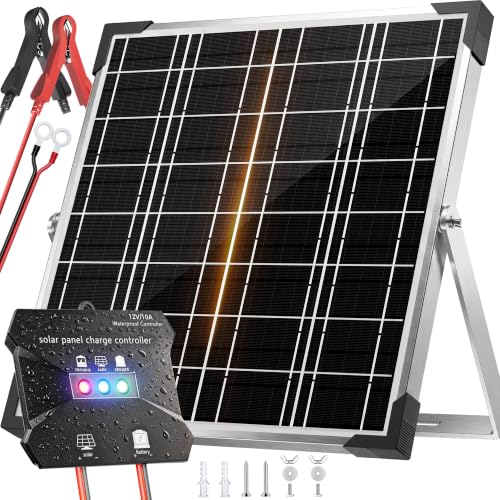
High-Efficiency MPPT Solar Charger - Advanced tracking technology delivers 20-30% faster charging for 12V batteries. A+ monocrystalline panels maximize power conversion. Perfect 20W solar trickle charger for cars, RVs, boats, and trailers. More sun captured, less time waiting.

50W Power That Maintains Your Battery: High-efficiency 50 watt solar panel / 50w solar panel delivers steady output even in low light. A true 12v solar battery charger that outperforms smaller panels and keeps car, RV, boat batteries alive longer.
Estimating Daily Power Usage
Estimate your daily power consumption by calculating the watt-hours for each device you plan to use. List your appliances and devices, along with their wattage and estimated usage time.
| Device | Wattage (W) | Hours Used/Day | Daily Power (Wh) |
|---|---|---|---|
| LED Lights | 10 | 5 | 50 |
| Refrigerator | 100 | 24 | 2400 |
| Heater | 1500 | 2 | 3000 |
| Phone Charger | 5 | 4 | 20 |
| Total | 5570 Wh |
Add the daily power usage for all devices to find your total daily power requirement. This figure reflects the total watt-hours (Wh) you need from your solar system each day.
Determining Solar Panel Output
Determine the solar panel output needed to meet your daily power consumption. Consider factors like solar panel efficiency, sunlight hours, and system losses.
- Calculate Required Panels: Divide your total daily power requirement by the average solar panel output per day. For example, if your total requirement is 5570 Wh and your solar panel produces 300 Wh per hour for 5 hours of effective sunlight:
[
300 \text{ Wh} \times 5 \text{ hours} = 1500 \text{ Wh/day}
]
To determine the number of panels:
[
\frac{5570 \text{ Wh}}{1500 \text{ Wh/panel}} \approx 3.71 \text{ panels}
]
Round up to 4 panels.
- Account for Efficiency: It’s important to consider system inefficiencies, which can be around 20%. Adjust your calculation accordingly. If you calculate a need for 4 panels, add one more for a total of 5 panels.
By accurately estimating daily power usage and understanding solar panel output, you can confidently select the appropriate solar panel size to maintain your RV battery during your travels.
Choosing the Right Solar Panel Size
Selecting the correct solar panel size is crucial for efficiently charging your RV battery. Understanding your needs and available options helps you achieve this goal.
Recommended Products

✔️【Waterproof Solar Charge Controller】IP67 waterproof, suitable for outdoor use. Automatically identify voltage, 12V Max power: 150W, 24V Max power: 300W. The maximum current is 10A. Compatible with various 12V/24V deep-cycle batteries, such as AGM, GEL, Flooded. Adopting brand MCU chips to realize fast intelligent control and ultra-low standby power consumption.

【Efficient Performance】This Starter Kit can generate an average of 500Wh of electricity per day (varies with sunlight). The solar panel boasts a 22.5% cell efficiency, 1.3% higher than other counterparts. Each panel dispatched from our facility undergoes 100% EL testing, ensuring that your panel is completely free from any hidden cracks.
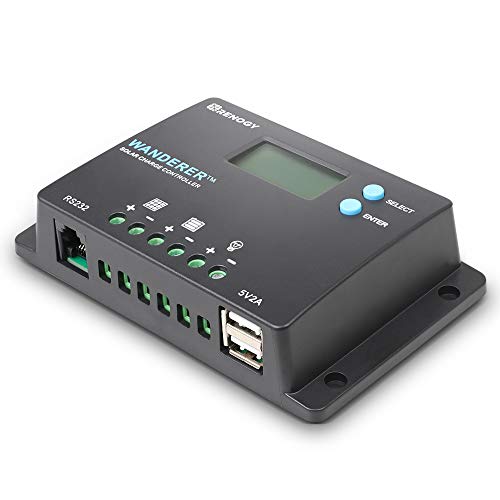
𝐒𝐦𝐚𝐫𝐭 𝟒-𝐒𝐭𝐚𝐠𝐞 12V/24V Solar Charge Controller: Renogy charge controller 𝐦𝐚𝐱𝐢𝐦𝐢𝐳𝐞𝐬 𝐁𝐚𝐭𝐭𝐞𝐫𝐲 𝐋𝐢𝐟𝐞 & 𝐒𝐨𝐥𝐚𝐫 𝐄𝐟𝐟𝐢𝐜𝐢𝐞𝐧𝐜𝐲, this advanced pwm solar charge controller utilizes intelligent 4-stage charging (Bulk/Boost/ Float/Equalization) to optimize power delivery for AGM, Gel, Flooded and Lithium batteries. RV solar charge controller prevents overcharging and gas buildup while 𝐚𝐜𝐡𝐢𝐞𝐯𝐢𝐧𝐠 𝟑𝟎% 𝐥𝐨𝐧𝐠𝐞𝐫 𝐛𝐚𝐭𝐭𝐞𝐫𝐲 𝐥𝐢𝐟𝐞𝐬𝐩𝐚𝐧 compared to basic charge controllers.
Recommended Sizes Based on Battery Types
Battery type influences solar panel size requirements. Here are typical recommendations:
- Lead-Acid Batteries: Use solar panels ranging from 100 to 200 watts. These batteries often require overnight charging and regular maintenance.
- AGM Batteries: Opt for panels in the 100 to 300-watt range. AGM batteries discharge smoothly and benefit from consistent power during travels.
- Lithium-Ion Batteries: Choose panels between 200 to 400 watts. These batteries charge faster and handle varied loads effectively.
Selecting the right panel size ensures optimum charging for your specific battery type.
Matching Solar Panel Output to Consumption
Matching your solar panel output with daily consumption helps maintain battery health. First, calculate your daily power usage. List each appliance, noting its wattage and average usage time. Multiply these figures to find daily watt-hours needed.
Follow these steps:
- List Appliances: Include everything from lights to refrigerators.
- Calculate Wattage: Example: A 60-watt light used for 5 hours consumes 300 watt-hours (60W x 5h).
- Sum Daily Needs: Total all watt-hours to get your daily requirement.
- Adjust for Efficiency: Apply a 20% buffer to account for system inefficiencies.
With the total watt-hours calculated, compare it to your solar panel’s output. If your panel produces enough energy, it will meet your charging needs. If there’s a shortfall, increase panel size or reduce power consumption. This practice keeps your RV battery charged and ready for adventure.
Additional Considerations
When selecting a solar panel for your RV battery, several additional factors come into play to maximize efficiency and effectiveness.
Recommended Products

Aluminum alloy 6063, surface anodizing (wear resistance, anti-corrosion, insulation)

Durable 6063 Aluminum Build: crafted from anodized 6063 aluminum, these adjustable solar panel tilt mount brackets offer enhanced durability, corrosion resistance, and electrical insulation; Designed for long-term outdoor use on rooftops, RVs, and boats, they stand resilient against challenging environments

【Adjustable angle 10°-60°】The support structure is designed to adjust the angle of the solar panels according to the position of the sun and lighting conditions, maximizing energy collection efficiency.
Panel Placement and Orientation
Proper placement and orientation of your solar panels significantly affect their performance. Aim to install panels in a location that receives maximum sunlight throughout the day. Positioning them on the roof of your RV is common, as this reduces shading from trees and buildings.
Tilt the panels at an angle that matches your geographical latitude. This angle allows the solar panel to capture sunlight more effectively. If possible, adjust the tilt seasonally for better performance. For example, a more upright angle works well in winter when the sun is lower in the sky.
Consider using a solar mount or tilt bracket. These tools enable adjustments in tilt and orientation during the day, optimizing sun exposure, especially if you park in varying locations.
Regulatory and Compatibility Issues
Before purchasing solar panels, check local regulations regarding solar installation on RVs. Some areas may have specific codes or restrictions, especially in public campgrounds or RV parks.
Ensure your solar panel system is compatible with your RV’s battery type and charge controller. Different battery types, such as lead-acid, AGM, and lithium-ion, may require specific charging profiles. Use a charge controller that matches the requirements of your batteries to avoid overcharging or damaging them.
Consider your inverter when planning your solar setup. The inverter converts DC power from solar panels into AC power for your appliances. Ensure it has the right capacity to support your power needs to prevent overloads.
By keeping these considerations in mind, you can effectively enhance your RV solar charging system, ensuring a reliable power source during your travels.
Conclusion
Choosing the right size solar panel for your RV battery can make all the difference in your travel experience. By understanding your power needs and the specifics of your battery type you’ll ensure your adventures are powered without a hitch.
Remember to consider factors like your daily energy consumption and local sunlight conditions. With the right setup you can enjoy the freedom of the open road while keeping your batteries charged and ready for all your journeys. So take the time to calculate and plan—you’ll be glad you did when you’re off exploring with peace of mind. Happy travels!
Frequently Asked Questions
How do solar panels charge RV batteries?
Solar panels charge RV batteries by converting sunlight into electricity using photovoltaic (PV) cells. When sunlight hits the cells, it generates direct current (DC), which is stored in the RV batteries. A charge controller manages this process, ensuring the batteries receive the correct voltage and preventing overcharging.
What are the best solar panel types for RVs?
The best solar panel types for RVs are monocrystalline, polycrystalline, and thin-film. Monocrystalline panels are the most efficient and space-saving, while polycrystalline panels are more affordable and slightly less efficient. Thin-film panels are lightweight and flexible but typically require more space for the same output.
What factors affect solar panel size for RV batteries?
Factors affecting solar panel size for RV batteries include power consumption, battery type, daily power needs, sunlight hours, and system efficiency. Knowing the wattage of your appliances and the duration of use helps in calculating the necessary solar output for efficient battery charging.
How do I calculate energy needs for my RV?
To calculate energy needs for your RV, list all appliances, their wattage, and average usage time per day. Multiply the wattage by usage hours to find total watt-hours. This total helps in determining the solar panel size necessary to meet your energy requirements.
How can I maximize the efficiency of my solar panels?
Maximizing solar panel efficiency involves proper placement and orientation to capture sunlight effectively. Adjusting the tilt based on your geographical latitude, using solar mounts for optimal exposure, and ensuring compatibility with your battery and charge controller will enhance overall performance.
