

Are you looking to power your devices with solar energy but unsure what size solar panel you need to charge a 50Ah battery? You’re not alone. Many people find themselves confused when trying to match the right solar panel to their battery capacity.
Key Takeaways
- Solar Panel Types: Understand the differences between monocrystalline, polycrystalline, and thin-film solar panels to choose the most suitable option for charging a 50Ah battery.
- Energy Requirements: A 50Ah battery needs about 600Wh of energy to charge, with daily usage ideally requiring replenishment of around 300Wh to maintain battery life.
- Solar Insolation Importance: Calculate required solar panel size based on local solar insolation, as it greatly impacts how much energy a solar panel can generate daily.
- Calculation for Panel Size: Use the formula (Daily Energy Needs / Hours of Peak Sunlight) to determine the solar panel wattage needed, considering a buffer for inefficiencies.
- Installation Factors: Optimize panel placement for maximum sunlight exposure and ensure proper connection with a charge controller to prevent overcharging and maintain battery health.
- Seasonal Adjustments: Be prepared to adjust solar panel sizes based on seasonal variations in sunlight and energy production to ensure continuous charging of your 50Ah battery.
Understanding Solar Panel Basics
Understanding the fundamentals of solar panels is essential for effectively charging a 50Ah battery. This section covers the types of solar panels available and the charging mechanisms involved.
Solar Panel Types
You can choose from several types of solar panels, each suited for different applications. The most common types include:
- Monocrystalline Solar Panels: Known for high efficiency and space-saving designs. These panels usually perform better in low-light conditions and can last 25 years or more.
- Polycrystalline Solar Panels: Generally more affordable, these panels have a lower efficiency rate but can still serve well in larger setups. They feature a distinct blue color due to their multiple silicon crystals.
- Thin-Film Solar Panels: Lightweight and flexible, these panels work well in portable applications. However, they require more space for installation since their efficiency is lower compared to crystalline options.
Charging Mechanism
The charging mechanism determines how solar energy converts to charge your battery. Here’s how it works:
- Solar Energy Conversion: Solar panels absorb sunlight and convert it into direct current (DC) electricity.
- Charge Controller: A charge controller regulates the voltage and current to the battery, preventing overcharging or undercharging. It maintains optimal charging conditions.
- Battery Storage: Your 50Ah battery stores the energy for later use. When it’s fully charged, the charge controller halts the charging process.
- Usage: You can draw on the stored energy to power devices, ensuring your battery operates efficiently.
Understanding these elements allows you to select the right solar panel size to effectively charge your 50Ah battery.
Factors Affecting Solar Panel Size
Several key factors determine the solar panel size required to charge a 50Ah battery efficiently. Understanding these factors helps you make informed decisions.
Recommended Products

【COMPACT & TRAVEL-READY】 Folds down to 19.3x20.9x1.1in and just 7.3lb—light enough to pack, carry, and set up solo. Perfect for RVs, vans, camping, or backup power.
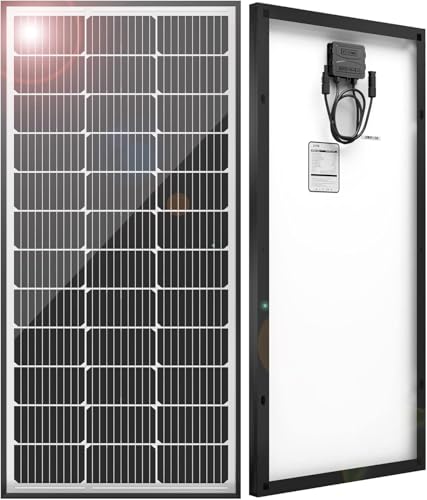
[Higher Efficiency, More Power Output] With Grade A+ large monocrystalline solar cells, this panel achieves a remarkable 23% conversion rate, outperforming conventional options. It generates up to 500Wh of electricity per day with 5 hours of direct sunlight. Unleash the potential of solar energy with our high-performance panel.

[Industry-Leading N-Type 25% Efficiency] Engineered with premium 16BB cell and N-Type technology, the Renogy 100w portable solar panel achieves 25% conversion efficiency - significantly outperforming standard 9BB 100w solar panel's 22.5% efficiency. This means you get more usable power from the same sunlight exposure, especially beneficial in space-constrained RV installations or cloudy conditions.
Battery Capacity
Battery capacity, measured in amp-hours (Ah), directly impacts how much energy a solar panel needs to generate. A 50Ah battery can store 600 watt-hours (Wh) of energy (50Ah x 12V). To charge it fully, you must consider both the depth of discharge and the charging time. For practical use, maintaining a discharge level of 50% increases battery longevity. Therefore, you need to replenish around 300Wh daily for this scenario. Choose a solar panel that can deliver this amount effectively, typically requiring around 100-150W of solar panel capacity to ensure sufficient charging while accounting for inefficiencies.
Solar Insolation
Solar insolation refers to the amount of solar power received per unit area over a specific time, usually measured in kilowatt-hours per square meter per day (kWh/m²/day). It varies based on your location, season, and time of day. For instance, sunny regions may receive up to 6-7 kWh/m²/day, while cloudier locations might only get 3-4 kWh/m²/day. To estimate the solar panel size needed, divide the total energy required (in watt-hours) by the daily solar insolation value in your area, multiplied by the panel efficiency. This calculation allows you to determine the optimal solar panel size for charging your 50Ah battery under specific conditions.
Recommended Solar Panel Size for 50Ah Battery
Choosing the right solar panel size for charging a 50Ah battery involves specific calculations and considerations. Understanding these factors helps in selecting an efficient solar power system.
Recommended Products

【Efficient Performance】This Starter Kit can generate an average of 500Wh of electricity per day (varies with sunlight). The solar panel boasts a 22.5% cell efficiency, 1.3% higher than other counterparts. Each panel dispatched from our facility undergoes 100% EL testing, ensuring that your panel is completely free from any hidden cracks.


Wide Compatibility: The Solar Charge Controller is automatically compatible with 12V or 24V systems and is suitable for a variety of batteries: lead-acid batteries, lithium iron phosphate batteries, and ternary lithium batteries.
Calculation Method
First, calculate the energy needs of the 50Ah battery. The energy stored in the battery equals its capacity multiplied by its voltage. For a common 12V battery:
- Energy Stored: 50Ah × 12V = 600Wh
To maintain the battery’s health, discharge it only to 50%. A daily replenishment target of around 300Wh is essential.
Next, account for the solar insolation for your location, which indicates how much sunlight you receive daily. Typically, insolation varies from 4 to 6 hours of peak sunlight per day. Use this estimation for calculation.
Calculate Required Solar Panel Size:
Use this formula:
[
\text{Solar Panel Size (W)} = \frac{\text{Daily Energy Needs (Wh)}}{\text{Hours of Peak Sunlight}}
]
For example, if your location averages 5 hours of peak sunlight:
[
\text{Solar Panel Size (W)} = \frac{300Wh}{5h} = 60W
]
Consider adding a buffer to account for inefficiencies. A panel size of 100-150W often covers variability in sunlight and energy losses due to system inefficiencies.
- **Scenario 1: **
- Location: Sunny Area
- Insolation: 6 hours of sunlight
- Calculation:
- Daily Energy Needs: 300Wh
- Required Size: 300Wh / 6h = 50W
- Suggested Panel Size: 100W (provides a cushion)
- **Scenario 2: **
- Location: Cloudy Area
- Insolation: 4 hours of sunlight
- Calculation:
- Daily Energy Needs: 300Wh
- Required Size: 300Wh / 4h = 75W
- Suggested Panel Size: 100-150W (to ensure enough energy)
- **Scenario 3: **
- Location: Seasonal Variation
- Insolation: Average of 5 hours in summer, 3 hours in winter
- Calculation for Summer:
- Daily Energy Needs: 300Wh
- Required Size: 300Wh / 5h = 60W
- Calculation for Winter:
- Required Size: 300Wh / 3h = 100W
- Suggested Panel Size: 150W (covers both seasons)
Adjust your solar panel size based on your specific location and seasonal variations. This approach ensures you maintain a charged and healthy 50Ah battery.
Installation Considerations
When setting up your solar panel system to charge a 50Ah battery, several factors influence installation. Proper placement, orientation, and connection methods significantly impact efficiency and performance.
Recommended Products

SMART SOLAR CHARGE CONTROLLER: Solar charge the smart way with the Victron Energy SmartSolar MPPT charge controller, to ensure that every ray of available sunlight is converted into usable energy, while optimizing battery longevity.
![[Upgraded] 30A PWM Solar Charge Controller with Auto Parameter LCD Display](https://m.media-amazon.com/images/I/41opvkWthjL._SL500_.jpg)
【UPGRADED SOLAR CONTROLLER】This solar charge controller helps you manage the working of solar panels and batteries in solar systems automatically with the build-in industrial microcontroller. You don't need to reset it when the battery runs out cause it will memorize various parameters set by the user

✔️【Waterproof Solar Charge Controller】IP67 waterproof, suitable for outdoor use. Automatically identify voltage, 12V Max power: 150W, 24V Max power: 300W. The maximum current is 10A. Compatible with various 12V/24V deep-cycle batteries, such as AGM, GEL, Flooded. Adopting brand MCU chips to realize fast intelligent control and ultra-low standby power consumption.
Placement and Orientation
Placement plays a crucial role in solar panel performance. Panels should be positioned in a location that receives maximum sunlight throughout the day, avoiding shadows from trees, buildings, or other obstructions. Aim for a south-facing orientation in the Northern Hemisphere or a north-facing orientation in the Southern Hemisphere for optimal exposure.
Tilt angles also matter. Adjust your solar panels based on your latitude. A general guideline is to set the tilt equal to your latitude for year-round efficiency. For additional seasonal performance, increase the angle by 15 degrees in winter and decrease by 15 degrees in summer.
Connection to Battery System
Connecting your solar panel to the battery system requires careful attention. Use a solar charge controller to regulate voltage and prevent overcharging. A charge controller ensures your 50Ah battery receives the right amount of energy without damaging it.
Follow these steps for connection:
- Select the Right Charge Controller: Choose one rated for your system’s voltage and current.
- Connect the Solar Panels: Attach the positive and negative wires from the solar panel to the corresponding terminals on the charge controller.
- Connect the Charge Controller to the Battery: Connect the positive wire from the charge controller to the battery’s positive terminal and the negative wire to the battery’s negative terminal.
- Check for Proper Function: Monitor the charge controller’s display to ensure the battery is charging correctly.
By paying attention to placement, orientation, and proper connections, you foster efficient energy conversion and enhance the lifespan of your 50Ah battery.
Conclusion
Choosing the right size solar panel to charge your 50Ah battery doesn’t have to be overwhelming. By understanding your energy needs and local sunlight conditions you can easily find the perfect fit. Remember to consider factors like panel efficiency and installation placement to maximize your system’s performance.
With a recommended panel size of 100-150W you’ll ensure your battery stays charged and healthy. Whether you’re using it for camping or off-grid living having the right setup will make all the difference. Enjoy the benefits of solar energy and the freedom it brings to your adventures!
Frequently Asked Questions
What size solar panel do I need to charge a 50Ah battery?
To charge a 50Ah battery, you typically need a solar panel with a capacity of 100-150W. This range accounts for energy losses and ensures sufficient power generation to maintain battery longevity.
How is a 50Ah battery’s energy requirement calculated?
A 50Ah battery can store 600 watt-hours (Wh) of energy. To preserve the battery, it’s advisable to discharge it only up to 50%, meaning you’ll need to replenish approximately 300Wh daily.
What types of solar panels are available?
The main types of solar panels are monocrystalline, polycrystalline, and thin-film. Each type has different efficiencies, costs, and applications, with monocrystalline panels generally being the most efficient.
How does solar energy charging work?
Solar panels convert sunlight into electricity, which is managed by a charge controller. This controller regulates the voltage to ensure the battery is charged safely and effectively without overcharging.
What is solar insolation and why is it important?
Solar insolation is the measure of solar power received in a specific area over time. It varies by location and season, influencing how much energy your solar panel can produce, which is crucial for calculating the size needed to charge a battery.
How can I determine the required solar panel size in different climates?
Calculate the energy needed (300Wh for a 50Ah battery) and consider your area’s average peak sunlight hours. For example, you might need a stronger panel in cloudy regions than in sunny areas to meet daily energy requirements.
What installation tips can enhance solar panel efficiency?
Proper placement and orientation of solar panels are crucial. In the Northern Hemisphere, panels should face south; in the Southern Hemisphere, they should face north. Adjusting the tilt angle according to your latitude helps maximize sunlight exposure.
Do I need a charge controller to connect my solar panel to a 50Ah battery?
Yes, a charge controller is essential. It regulates the voltage from the solar panel to the battery, preventing overcharging and helping to manage energy flow, which protects the battery’s lifespan and efficiency.
