

Ever wondered how many solar panels you need to charge a 100Ah battery? You’re not alone. Many people are looking to harness solar energy for their homes, RVs, or off-grid setups but struggle with figuring out the right amount of panels.
Imagine you’re planning a weekend getaway in your camper. You want to ensure your battery stays charged, but you’re unsure how many panels to set up. This article will break down the calculations and factors you need to consider. By the end, you’ll have a clear understanding of how to optimize your solar setup, ensuring you enjoy your adventures without worrying about battery life.
Key Takeaways
- Understanding Battery Capacity: A 100Ah battery can power a device for 100 hours at 1 amp; knowing this helps in planning energy consumption and solar charging strategies.
- Solar Panel Types: Choose between monocrystalline, polycrystalline, and thin-film solar panels, each with different efficiency levels and space requirements.
- Charging Calculations: Determine the number of solar panels needed using the formula: Number of Panels = Daily Energy Needs / Solar Panel Output.
- Factors Affecting Charging: Sunlight exposure, panel efficiency, and ambient temperature significantly influence charging time and efficiency.
- Location Matters: Geographic location, roof orientation, and seasonal variations affect solar energy production and should be factored into the panel installation plan.
- Practical Considerations: Regularly evaluate system performance against energy needs to ensure reliable power supply and optimize solar panel usage.
Understanding Battery Capacity
Understanding battery capacity is crucial for effectively charging your 100Ah battery with solar energy systems. Battery capacity determines how much energy you can store and use, influencing your solar panel requirements.
What Is a 100Ah Battery?
A 100Ah (amp-hour) battery can supply 100 amps for one hour or 1 amp for 100 hours. This rating indicates how much energy the battery can store and discharge over time. For example, if you use a load that draws 10 amps, a fully charged 100Ah battery can power it for 10 hours before needing a recharge. Knowing this helps plan your energy consumption and solar charging strategy effectively.
Importance of Battery Capacity in Solar Systems
Battery capacity plays a vital role in solar systems. A higher capacity allows for more energy storage, enabling you to use appliances and devices even when sunlight isn’t available. Properly assessing your energy needs ensures you choose the right battery and solar panel configuration. For instance, if your daily energy consumption is 200Wh (watt-hours), you’ll require a battery setup capable of handling that load while leaving some reserve capacity. Balancing battery size and solar input optimizes your system’s efficiency, providing a seamless power supply for your needs.
Solar Panel Basics
Understanding solar panel functionality is essential for optimizing your battery charging. Solar panels convert sunlight into electricity, helping to charge your 100Ah battery efficiently in various scenarios.
Types of Solar Panels
- Monocrystalline Panels:
- Monocrystalline panels provide high efficiency and space savings.
- They’re made from single-crystal silicon, making them ideal for limited spaces.
- Expect an efficiency rate of 15% to 22%.
- Polycrystalline Panels:
- Polycrystalline panels are cost-effective options with slightly lower efficiency.
- They’re made from multiple silicon crystals, making them affordable, albeit less efficient, with rates between 13% and 16%.
- Thin-Film Panels:
- Thin-film panels are lightweight and flexible, making installation versatile.
- However, they tend to have lower efficiency ratings, ranging from 10% to 12%.
- They may require more space for the same energy output.
How Solar Panels Generate Electricity
Solar panels generate electricity through a photovoltaic process. Here’s how it works:
- Absorption of Sunlight:
- Solar cells inside the panels absorb sunlight and create electrical currents.
- Electron Movement:
- When sunlight hits the solar cells, it knocks electrons loose from their atoms, initiating an electric current.
- Direct Current (DC) Generation:
- This process creates direct current (DC) electricity, which is the initial form of electricity generated.
- Inverter Conversion:
- An inverter converts DC electricity into alternating current (AC) if needed for household appliances.
- Charging Your Battery:
- The generated electricity flows to your 100Ah battery, allowing it to charge efficiently.
Understanding these basics allows you to determine how many solar panels you require to effectively charge your battery, ensuring you have ample power for your needs.
Calculating Solar Panel Requirements
Determining how many solar panels you need to charge a 100Ah battery involves several steps and considerations. The right calculations help ensure your battery stays charged for your specific energy needs.
Recommended Products

12V Universal Solar Charge Controller- Renogy Solar controller optimizes charging for 𝐋𝐢𝐭𝐡𝐢𝐮𝐦, 𝐀𝐆𝐌, 𝐆𝐞𝐥, & 𝐅𝐥𝐨𝐨𝐝𝐞𝐝 𝐛𝐚𝐭𝐭𝐞𝐫𝐢𝐞𝐬. Smart PWM solar panel controller technology auto-selects the perfect charging curve (𝐁𝐮𝐥𝐤/𝐁𝐨𝐨𝐬𝐭/ 𝐅𝐥𝐨𝐚𝐭/ 𝐄𝐪𝐮𝐚𝐥𝐢𝐳𝐚𝐭𝐢𝐨𝐧) for your RV, boat, or off-grid setup. Renewable energy controllers easily switch battery types and monitor real-time charging stages via intuitive LEDs, mmaximizing battery lifespan.

【Superior MPPT Technology】 This 100A MPPT solar controller is equipped with an advanced MPPT maximum power point tracking technology algorithm. It automatically recognizes 12V/24V/36V/48V systems and features dual USB 5V charging ports. The controller can swiftly track the maximum power point of the PV array in any environment, ensuring a tracking efficiency of no less than 99.5%. This significantly enhances the energy utilization in the solar system.
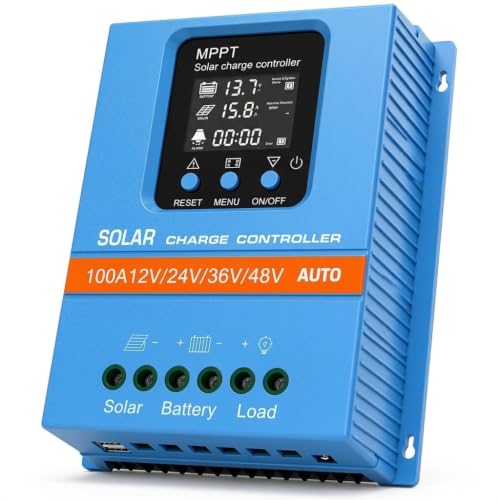
【Product Advantages 】: 100A intelligent adjustment controller with precise time control and light control, can switch loads on and off at a fixed time, adjustable voltage parameters, and memory function. Large LED display screen, real-time display of working voltage, clearer data reading. Flame retardant materials are safe and durable, fashionable and simple. Large section wiring port, wire spacing increased by 99mm
Factors Affecting Charging Time
Several factors influence how long it takes to charge a 100Ah battery with solar panels:
- Sunlight Exposure: More direct sunlight results in faster charging. Geographical location and seasonal changes affect sunlight availability.
- Panel Efficiency: Efficient panels convert more sunlight into electricity. Choose high-efficiency options when space is limited.
- Battery State of Charge: If the battery is already partially charged, it’ll take less time to fill it up completely.
- System Losses: Inverter efficiency and other losses can reduce the total energy captured. Typically, consider about 10-20% loss in your calculations.
- Ambient Temperature: High temperatures can decrease panel efficiency, while low temperatures may enhance it.
Formula for Calculation
To find out how many solar panels you require, use this formula:
- Daily Energy Needs: Calculate your daily energy consumption in watt-hours (Wh). For example, if you use 200Wh daily, that’s your baseline.
- Battery Capacity: A 100Ah battery at 12 volts holds 1,200Wh (100Ah × 12V).
- Panel Output: Determine the output of your solar panels. A common 100W solar panel produces around 300Wh on a sunny day, assuming 3 hours of effective sunlight.
- Calculation: Use the formula:
[
\text{Number of Panels} = \frac{\text{Daily Energy Needs}}{\text{Solar Panel Output}}
]
For example, if your daily need is 200Wh, you would need:
[
\text{Number of Panels} = \frac{200Wh}{300Wh} \approx 0.67 \text{ panels}
]
Round up to 1 panel for a fully efficient setup.
This formula gives you a starting point. Adjust based on factors affecting charging time and energy efficiency to optimize your solar system.
Practical Considerations
Understanding practical considerations ensures effective solar panel utilization for charging a 100Ah battery. Focus on factors like location, sunlight access, seasonal changes, and energy consumption patterns to optimize your solar setup.
Recommended Products


【BMS Protection of 12V 100Ah Batteries】-Our LiFePO4 battery has built-in 100A BMS to protect it from overcharging, over-discharging, over-current, overheating and short circuits with excellent self-discharge rate, low Self-discharge rate and high discharge Rate, ensuring the LiFePO4 battery's safety level and optimize the 12V battery performance.The battery can be recharged in three ways, a lithium iron phosphate battery charger (14.6V 20A charger recommended, 5 hours of fast charge), a solar panel with controller and an alternator.

【COMPACT & TRAVEL-READY】 Folds down to 19.3x20.9x1.1in and just 7.3lb—light enough to pack, carry, and set up solo. Perfect for RVs, vans, camping, or backup power.
Location and Sunlight Availability
Location heavily influences the number of solar panels required. Assess your site’s exposure to sunlight throughout the day. Installer guidance typically identifies regions with optimal sun exposure.
Consider these variables:
- Geographic Location: Areas closer to the equator receive more sunlight and can benefit from fewer solar panels.
- Orientation and Tilt: South-facing roofs capture maximum sunlight in the Northern Hemisphere. Adjust angle according to season for optimal energy capture.
- Obstructions: Trees, buildings, and other structures can create shade, reducing solar efficiency. Identify any obstructions nearby to calculate necessary panel adjustments.
Seasonal Variations and Their Impact
Understand that seasons affect solar energy production. Solar panels typically generate less power during winter months due to shorter days and lower sunlight intensity.
Key considerations include:
- Winter: Expect reduced sunlight; consider additional panels or energy storage solutions for consistent power.
- Summer: Longer days and higher angle of the sun increase energy production, allowing solar panels to charge the battery more effectively.
- Cloud Cover and Rain: Inclement weather reduces efficiency. Account for days when sunlight is less available and ensure your system can handle power fluctuations.
By considering these factors, you can better determine how many solar panels to install. This ensures efficient charging of your 100Ah battery, providing reliable energy for your needs.
Conclusion
Getting the right number of solar panels to charge your 100Ah battery can make all the difference in your energy setup. By considering factors like your daily energy needs and sunlight exposure, you can ensure a reliable power source for your adventures.
Whether you’re camping or living off-grid, understanding your battery’s capacity and the efficiency of your solar panels will help you optimize your system. With the right calculations and a bit of planning, you’ll be ready to enjoy worry-free trips powered by the sun.
So go ahead and dive into those calculations—your next adventure awaits!
Frequently Asked Questions
How many solar panels are needed to charge a 100Ah battery?
To charge a 100Ah battery effectively, you typically need at least one 100W solar panel, assuming an average daily energy consumption of around 200Wh and optimal sunlight conditions. Factors such as panel efficiency and sunlight exposure will influence this requirement.
What is a 100Ah battery?
A 100Ah battery can supply 100 amps for one hour or 1 amp for 100 hours. It indicates the battery’s capacity, helping you understand how much energy it can store and discharge over time, essential for planning your solar energy needs.
What types of solar panels are available?
There are three main types of solar panels: monocrystalline (high efficiency and space-saving), polycrystalline (cost-effective but slightly less efficient), and thin-film (lightweight and flexible but lower efficiency). Each type has its advantages based on your energy requirements.
How does sunlight exposure affect solar panel performance?
Sunlight exposure significantly impacts solar panel efficiency. More sunlight results in higher energy production. Geographic location, roof orientation, and potential obstructions (like trees or buildings) can affect the amount of sunlight your panels receive throughout the year, especially during seasonal changes.
Can I charge a 100Ah battery with just one solar panel?
Yes, you can charge a 100Ah battery with one appropriately sized solar panel, like a 100W panel, under optimal conditions. However, ensure to consider your daily energy consumption and panel efficiency to achieve reliable charging.
What factors should I consider when calculating solar panel requirements?
When calculating solar panel needs, consider daily energy consumption, battery capacity, panel output, sunlight exposure, system losses, and ambient temperature. These factors will help ensure you have enough power to keep your 100Ah battery charged effectively.
How does temperature influence solar panel efficiency?
Ambient temperature affects solar panel efficiency; colder temperatures can improve panel output, while excessive heat can reduce it. Consider installation in shaded areas or use panels designed to handle higher temperatures to maximize solar efficiency.
Why is battery capacity important in solar systems?
Battery capacity is crucial in solar systems as it determines how much energy you can store for later use. Higher capacity allows for longer usage periods without sunlight and enables running appliances efficiently, ensuring a reliable energy supply.
