

Ever wondered how long it takes for a 100W solar panel to charge a 100Ah battery? If you’re exploring solar power for your home or an off-grid adventure, this question is key. Understanding the charging time can help you plan your energy needs effectively.
Key Takeaways
- Charging Duration: A 100W solar panel can take up to 15 hours to fully charge a 100Ah battery under optimal sunlight conditions, accounting for approximately 20% efficiency loss.
- Real-World Factors: The actual charging time can vary based on sunlight availability, battery charge level, and solar panel orientation.
- Battery Type Matters: Differences in battery types (e.g., lead-acid vs. lithium-ion) impact charging times and efficiency, with lithium-ion batteries generally charging faster.
- Monitor Conditions: Weather conditions significantly affect solar output; cloud cover and shading can extend charging times.
- Use a Charge Controller: Implementing a solar charge controller is essential for protecting the battery and optimizing charging efficiency, particularly during variable weather conditions.
- Plan Ahead: Anticipating variables like battery state and effective sunlight hours assists in effective energy planning, ensuring your solar setup meets energy needs efficiently.
Understanding Solar Panel Charging
Charging a 100Ah battery with a 100W solar panel involves several key factors.
Key Calculation Factors
- Solar Panel Output: A 100W solar panel produces about 100 watts of power under ideal conditions. Actual output varies due to shading, temperature, and angle.
- Battery Capacity: A 100Ah battery stores 1,200 watt-hours (100Ah × 12V = 1,200Wh). This capacity determines how much energy you’ll need to charge it fully.
- Efficiency Loss: Charging isn’t 100% efficient. Account for approximately 20% loss due to heat and energy conversion, meaning you’ll require around 1,440 watt-hours to fully charge the battery (1,200Wh ÷ 0.8 = 1,500Wh).
Charging Time Calculation
To calculate the time it takes to charge the battery, use the formula:
[
\text{Charging Time (in hours)} = \frac{\text{Battery Capacity (Wh)}}{\text{Solar Panel Output (W)}}
]
Plugging in the values:
[
\text{Charging Time} = \frac{1,500Wh}{100W} = 15 \text{ hours}
]
Under optimal sunlight, it takes about 15 hours to fully charge a 100Ah battery using a 100W solar panel.
Real-World Considerations
- Sunlight Availability: The number of effective sunlight hours varies by location and season. If your location averages 5 peak sunlight hours per day, charging will occur over three days (15 hours ÷ 5 hours per day = 3 days).
- Battery State of Charge: If the battery is not fully depleted, charging time reduces. For example, if the battery is at 50%, it only needs about 600Wh to reach full charge, reducing the time needed to 6 hours with optimal conditions.
- Position Your Panel: Ensure the solar panel faces the sun directly to maximize output.
- Monitor Battery Levels: Use a battery monitor to track charging progress and avoid overcharging.
- Consider a Charge Controller: A solar charge controller enhances charging efficiency and protects the battery from damage.
By understanding these factors, you can efficiently manage solar panel charging for your 100Ah battery.
Factors Affecting Charging Time
Several factors influence how long it takes for a 100W solar panel to charge a 100Ah battery. Understanding these factors helps in planning and maximizing efficiency during the charging process.
Recommended Products
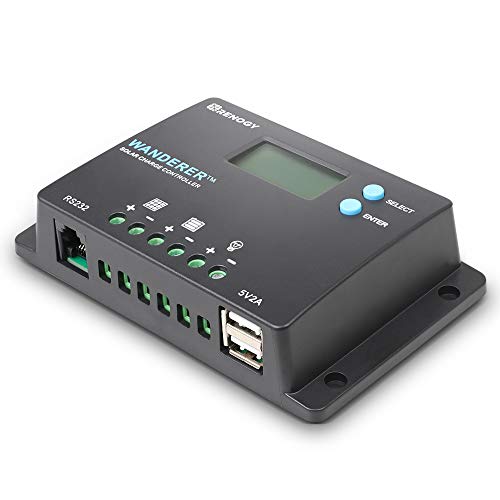
𝐒𝐦𝐚𝐫𝐭 𝟒-𝐒𝐭𝐚𝐠𝐞 12V/24V Solar Charge Controller: Renogy charge controller 𝐦𝐚𝐱𝐢𝐦𝐢𝐳𝐞𝐬 𝐁𝐚𝐭𝐭𝐞𝐫𝐲 𝐋𝐢𝐟𝐞 & 𝐒𝐨𝐥𝐚𝐫 𝐄𝐟𝐟𝐢𝐜𝐢𝐞𝐧𝐜𝐲, this advanced pwm solar charge controller utilizes intelligent 4-stage charging (Bulk/Boost/ Float/Equalization) to optimize power delivery for AGM, Gel, Flooded and Lithium batteries. RV solar charge controller prevents overcharging and gas buildup while 𝐚𝐜𝐡𝐢𝐞𝐯𝐢𝐧𝐠 𝟑𝟎% 𝐥𝐨𝐧𝐠𝐞𝐫 𝐛𝐚𝐭𝐭𝐞𝐫𝐲 𝐥𝐢𝐟𝐞𝐬𝐩𝐚𝐧 compared to basic charge controllers.

[100A SOLAR CHARGE CONTRALLER] Solar Charge controller compatibility with 12V and 24V system,Advanced maximum power point tracking (PWM) technology can improve efficiency by 10%-30%. High quality components improve system performance, super fast tracking speed ensures tracking efficiency

【Efficient Performance】This Starter Kit can generate an average of 500Wh of electricity per day (varies with sunlight). The solar panel boasts a 22.5% cell efficiency, 1.3% higher than other counterparts. Each panel dispatched from our facility undergoes 100% EL testing, ensuring that your panel is completely free from any hidden cracks.
Battery Capacity and Type
Battery capacity and type significantly impact charging time. A 100Ah lead-acid battery charges differently than a lithium-ion battery. Lead-acid batteries experience voltage drops and take longer to recharge, while lithium-ion batteries charge more quickly and efficiently. Assessing the type of battery not only determines your charging time but also impacts overall performance. Keep in mind that as battery capacity increases beyond 100Ah, charging time also increases.
Solar Panel Output
Solar panel output directly affects charging speed. A 100W panel produces 100 watts in ideal conditions, but real-world factors can lower this output. If your panel is shaded, its output diminishes, extending charging time. Additionally, ensure your solar panel is oriented correctly toward the sun to maximize exposure throughout the day. Checking your panel’s output regularly can provide valuable insights into its performance.
Weather Conditions
Weather conditions play a crucial role in solar charging. Cloudy days result in reduced sunlight, which decreases the energy absorbed by the solar panel. Rain and overcast skies can further extend charging times. On sunny days, you might achieve optimal charging rates, but if conditions change, be prepared for delays. Tracking local weather forecasts can help you anticipate your charging capabilities and plan accordingly.
Calculation Methodology
Understanding the calculation methodology for charging a 100Ah battery with a 100W solar panel helps you anticipate how long the process will take. This section outlines the formula used to determine charging time and provides example calculations for clarity.
Recommended Products

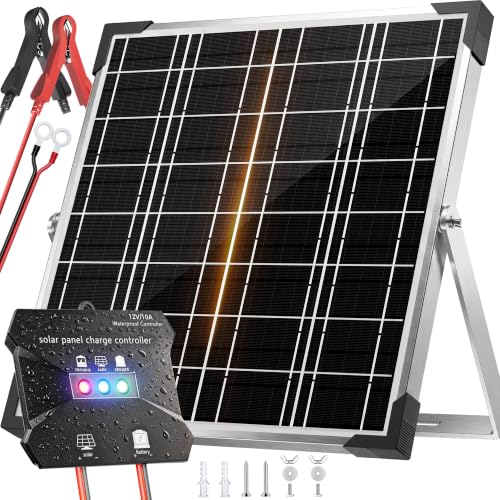
High-Efficiency MPPT Solar Charger - Advanced tracking technology delivers 20-30% faster charging for 12V batteries. A+ monocrystalline panels maximize power conversion. Perfect 20W solar trickle charger for cars, RVs, boats, and trailers. More sun captured, less time waiting.

【100W Solar Panel for Solar Generators】Our 100W solar panel delivers steady 19.8V/100W power with XT60 output, supporting 12V batteries up to 12A max. The 100 watt solar panel kit works with most portable power stations for RV camping, emergency backup, and outdoor power needs.
Formula for Charging Time
To calculate the charging time, use the following formula:
Charging Time (hours) = Battery Capacity (Wh) / Solar Panel Output (W)
Given that a 100Ah battery stores 1,200 watt-hours (1Ah = 12V x 100Ah) and a 100W solar panel produces 100 watts under ideal conditions, it takes:
Charging Time = 1,200Wh / 100W = 12 hours
However, considering approximately 20% efficiency loss due to various factors (like heat and battery management system), you should adjust the time:
Adjusted Charging Time = 1,500Wh / 100W = 15 hours
This adjustment means under optimal sunlight conditions, you can expect around 15 hours to fully charge your battery.
Example Calculations
Let’s illustrate the calculation with different scenarios to give you a practical perspective.
Example 1: Full Charge from Empty
- Battery Capacity: 100Ah (1,200Wh)
- Solar Panel Output: 100W
- Time Calculation:
- Without loss: 12 hours
- With 20% loss: 15 hours
You’d start charging and expect to wait approximately 15 hours for a full charge under perfect conditions.
Example 2: Partial Charge Calculation
Assume a partially charged battery at 50Ah (600Wh):
- Remaining Capacity: 500Wh (1,200Wh – 600Wh)
- Time Calculation:
- Without loss: 5 hours
- With 20% loss: 6.25 hours
For a 50% charge, you’d require around 6.25 hours for a complete charge under ideal conditions.
Example 3: Low Sunlight Conditions
If your solar panel receives only 60W due to cloud cover:
- Charging Time:
- Total Requirement: 1,500Wh
- Time Calculation:
- 1,500Wh / 60W = 25 hours
In low sunlight, expect 25 hours to charge fully.
To effectively manage your charging process, consider these calculations while monitoring your solar input and battery state. Addressing these factors will improve your energy planning.
Practical Considerations
Understanding practical aspects of using a 100W solar panel to charge a 100Ah battery enhances your energy management. Consider efficiency losses and the role of a charge controller for optimal performance.
Recommended Products

SMART SOLAR CHARGE CONTROLLER: Solar charge the smart way with the Victron Energy SmartSolar MPPT charge controller, to ensure that every ray of available sunlight is converted into usable energy, while optimizing battery longevity.

SOLAR CHARGE CONTROLLER: Victron Energy BlueSolar MPPT Solar Charge Controller with multi-stage battery charging algorithm compatible with AGM, Gel, LiFePO4, and flooded lead-acid batteries.

【Superior MPPT Technology】 This 100A MPPT solar controller is equipped with an advanced MPPT maximum power point tracking technology algorithm. It automatically recognizes 12V/24V/36V/48V systems and features dual USB 5V charging ports. The controller can swiftly track the maximum power point of the PV array in any environment, ensuring a tracking efficiency of no less than 99.5%. This significantly enhances the energy utilization in the solar system.
Efficiency Losses
Charging a battery doesn’t happen without some losses. Efficiency losses stem from several factors, primarily heat and conversion inefficiencies in the charging system. Generally, expect a loss of about 20% during charging, meaning a 100Ah battery requires roughly 1,500 watt-hours for a full charge.
For example, if you’re using your solar panel in ideal sunlight conditions, you might only utilize 80 watts of effective output due to inefficiencies. Thus, while your solar panel is rated at 100 watts, practical usage might yield lower energy. This reality impacts your overall charging time significantly. You can mitigate these losses by ensuring your solar panel receives direct sunlight and is clean of debris.
Charge Controller Impact
A solar charge controller plays a vital role in your charging setup. It regulates voltage and current flowing from the solar panel to the battery. This regulation protects the battery from overcharging and ensures efficient charging rates.
Choosing a quality charge controller can enhance charging performance significantly. For instance, an MPPT (Maximum Power Point Tracking) charge controller can be more efficient than a PWM (Pulse Width Modulation) controller, especially under variable sunlight conditions. With an MPPT, more solar power gets converted into usable energy.
For your setup, selecting the correct type of charge controller based on your battery type and solar panel output ensures you maximize your charging efficiency and protect your battery’s lifespan.
Conclusion
Charging a 100Ah battery with a 100W solar panel can be a straightforward process if you keep a few key factors in mind. By understanding the impact of sunlight availability and using a quality solar charge controller you can optimize your setup for better efficiency.
While it might take around 15 hours of ideal sunlight to fully charge your battery remember that real-world conditions can vary. Monitoring your battery levels and adjusting your setup accordingly will help you make the most of your solar energy.
With a little planning and awareness you can ensure your battery stays charged and ready for whatever you need. Enjoy harnessing the power of the sun for your energy needs!
Frequently Asked Questions
How long does it take to charge a 100Ah battery with a 100W solar panel?
Charging a 100Ah battery with a 100W solar panel typically takes about 15 hours under ideal sunlight conditions. However, various factors like sunlight availability, the battery’s current state of charge, and panel positioning can extend this time.
What formula is used to calculate the charging time for a battery?
The formula to calculate charging time is: Charging Time (hours) = Battery Capacity (Wh) / Solar Panel Output (W). For a 100Ah battery, which requires approximately 1,500 watt-hours, this calculation helps estimate charging time.
What factors affect the charging efficiency of a solar panel?
Charging efficiency can be affected by several factors, including the solar panel’s output, the battery type, weather conditions, shading, and the effectiveness of the charging equipment used, such as a solar charge controller.
Why is a solar charge controller important for charging batteries?
A solar charge controller regulates the voltage and current coming from the solar panel, protecting the battery from overcharging and improving charging performance. It helps extend the battery’s lifespan by ensuring optimal charging conditions.
How do heat and conversion losses impact charging efficiency?
Heat and conversion losses can reduce the effective output of a solar panel. For example, a 100W panel may only provide around 80 watts under real-world conditions, leading to longer charging times for the connected battery.
Do battery types affect charging speed?
Yes, battery types significantly impact charging speed. For instance, lithium-ion batteries generally charge faster than lead-acid batteries, making them more suitable for quick charging solutions in solar power systems.
What should I monitor when charging a battery with solar power?
When charging a battery with solar power, it’s essential to monitor battery levels to prevent overcharging or deep discharging, which can damage the battery. Additionally, checking solar panel output and sunlight conditions will optimize charging efficiency.
