

Troubleshooting the Charging System
If your gas-powered Club Car isn’t charging the battery, here are some steps to troubleshoot the charging system:
- Check the Power Source: Make sure the charger is properly plugged into an outlet and the power cord is connected to the Club Car.
- Inspect the Charger: Look for any visible damage or loose connections on the charger.
- Test the Outlet: Verify that the outlet is working correctly by plugging in another device.
- Check Battery Connections: Ensure the battery cables are securely connected and free of corrosion.
- Inspect Fuses: Look for any blown fuses in the Club Car’s electrical system.
- Test the Charging Process: Monitor the charging process to see if the battery is receiving power.
- Consider Battery Age: If the battery is old, it may not hold a charge or be able to be recharged.
- Consult a Professional: If the issue persists, it might be best to seek help from a mechanic or Club Car technician.
Remember to follow these steps carefully to identify and resolve any issues with your Club Car’s charging system.
Recommended Products

【15 Amp Rapid Charger/Lead-Acid】 EPOWREY 48 volt battery charger for Club Car golf carts with 3-pin round plug.This charger is designed as a one-piece plug, using a rubber cord that is more abrasion-resistant and heat-resistant than PVC cords, and have effective waterproofing advantage.

Club Car Models: Club car 48 volt charger plug suitable for 1995-Up Club Car DS and Precedent golf cart.
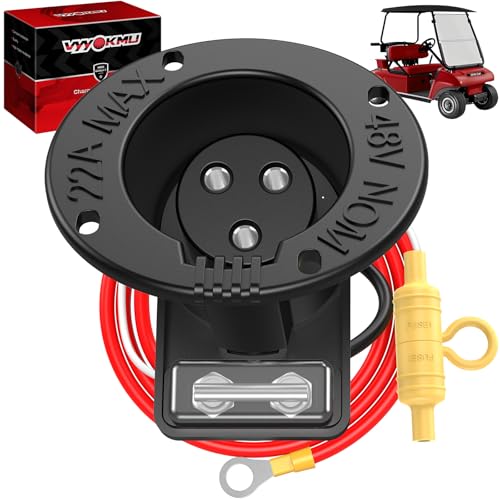
[Applicable Models]: Our 48V golf cart charging port is suitable for Club Car DS 1995-UP, OEM# 101802101 1018021-01. Please confirm the model of the golf cart before purchasing, it’s not suitable for 36V models
Checking the Battery Connections
When your gas-powered Club Car is not charging the battery, one of the first areas to inspect is the battery connections. Loose or corroded connections can prevent the proper flow of electricity, hindering the charging process. Here’s how you can effectively check and address this issue:
- Start by turning off the vehicle to ensure safety while working on the battery connections.
- Carefully inspect the battery terminals for any signs of corrosion, dirt, or damage. Clean terminals can improve the electrical contact and charging efficiency.
- Tighten the connections to ensure they are snug and secure. Loose connections can lead to charging problems.
- Follow the manufacturer’s guidelines for checking and maintaining battery connections to avoid any damage or accidents.
Regularly monitoring and maintaining your battery connections can enhance the overall performance of your Club Car’s charging system, ensuring that your vehicle stays powered up and ready for your next ride.
| Important Note |
|---|
| It’s crucial to handle battery connections with caution to prevent any electrical hazards or damage to the vehicle. |
Testing the Voltage Regulator
When troubleshooting charging issues in your gas-powered Club Car, Testing the Voltage Regulator is a crucial step to ensure proper functioning. Here are some steps to help you with this process:
- Check the Voltage Output: Use a multimeter to measure the voltage output from the regulator. A healthy voltage regulator typically maintains a stable output within a specific range.
- Inspect for Physical Damage: Look for any signs of physical damage such as corrosion, burnt marks, or loose connections on the voltage regulator. These issues can impede its performance.
- Test the Voltage Regulator Circuit: Verify that the voltage regulator circuit is functioning correctly by checking for continuity and proper connections. A faulty circuit can lead to charging problems.
- Compare Readings: Compare the voltage output readings from the regulator with the manufacturer’s specifications. Deviation from these values may indicate a malfunctioning voltage regulator.
Regularly testing the voltage regulator can help diagnose charging issues in your Club Car and ensure that the battery receives the necessary power for optimal performance. Remember, accurate testing and timely replacement of a faulty voltage regulator can prevent further charging complications.
Recommended Products

Voltage regulator rectifier for Club Car DS & Carryall 1992-up gas golf cart

12 Volt voltage regulator with 3 pin connector

Fits Club Car Models: 1992-Up Club Car DS & Carryall Gas Golf Cart.
Inspecting the Charging Circuit
When troubleshooting a gas-powered Club Car not charging its battery, inspecting the charging circuit is crucial. Here’s what you need to do:
- Begin by visually inspecting all wiring and connections for any signs of corrosion or damage.
- Check for loose connections that could disrupt the flow of electricity in the circuit.
- Look out for any visible wear or fraying on the cables that could indicate a potential issue.
Once you have visually inspected the circuit, proceed to test it to ensure it’s functioning correctly:
- Test the continuity of the circuit using a multimeter to identify any breaks in the wiring.
- Verify that the current can flow seamlessly through the circuit without interruptions or voltage drops.
By thoroughly inspecting the charging circuit and conducting tests, you can pinpoint any potential issues that may be causing the charging problem in your gas-powered Club Car.
Recommended Products

Battery Level Meter: The battery indicator is used to measure the remaining charge of the devices, equipments and battery-powered vehicles.

[Suitable for] Club Car Charger Receptacle for 48V Club Car DS 1995-UP(NOT for 36V)

{A Must Have LED Battery Monitor Indicator } - The battery indicator is used to measure the remaining charge in the golf cart battery, including lithium battery, lead acid battery, lithium iron phosphate battery, 3-15 series lithium ion battery, storage battery, water battery and other different battery types.Freely switching voltage among 12V 24V 36V 48V 60V 72V
Conclusion
Ensuring the proper functioning of the Voltage Regulator and the charging circuit is key to resolving battery charging issues in your gas-powered Club Car. By following the outlined steps to test and inspect these components, you can pinpoint and rectify any underlying problems affecting the charging system. Remember, a thorough examination of the circuitry can save you time and effort in diagnosing and fixing potential issues. Keep these troubleshooting tips in mind to keep your Club Car running smoothly and efficiently.
Frequently Asked Questions
Is testing the Voltage Regulator important in troubleshooting charging problems in a gas-powered Club Car?
Yes, testing the Voltage Regulator is crucial. Steps involve checking voltage output, physical damage, and comparing readings with manufacturer specifications.
How important is it to inspect the charging circuit in troubleshooting charging issues?
Inspecting the charging circuit is essential. It includes visually checking wiring for damage, testing continuity with a multimeter, and ensuring seamless current flow.
Why is thorough inspection and testing of the circuit necessary?
Thorough inspection helps identify issues causing charging problems, ensuring proper troubleshooting and fixing of potential issues in the vehicle’s charging system.
