

Are you looking to power up a 40Ah battery with solar energy? You’re not alone. Many people want to harness the sun’s power to keep their batteries charged, whether for RVs, boats, or off-grid setups. But figuring out the right solar panel size can be tricky.
Key Takeaways
- Understand Battery Types: Recognize the differences between lead-acid and lithium-ion 40Ah batteries, as each has unique charging requirements and lifespan considerations.
- Calculate Daily Energy Needs: Determine your daily energy consumption to assess the appropriate solar panel wattage necessary to charge your 40Ah battery effectively.
- Consider Sunlight Availability: Evaluate the average daily sunlight hours in your area, as this impacts the size and efficiency of the solar panel setup.
- Choose the Right Solar Panel: Opt for a solar panel within the 100 to 150-watt range for optimal charging of a 40Ah battery, factoring in system losses and efficiency rates.
- Installation Matters: Ensure proper installation and positioning of solar panels to maximize sunlight exposure and enhance energy capture.
- Monitor and Maintain: Regularly check the connections and monitor the performance of the solar charging system to maintain efficiency and battery health.
Understanding the 40Ah Battery
The 40Ah battery is a popular choice for various applications due to its versatility and efficiency. It’s crucial to understand its characteristics and common uses to optimize solar panel sizing.
Battery Type and Characteristics
40Ah batteries commonly come in two main types: lead-acid and lithium-ion.
- Lead-Acid Batteries: These batteries are cost-effective and widely used. They typically provide reliable performance for RVs or boats. However, lead-acid batteries should not be discharged below 50% to prolong their lifespan.
- Lithium-Ion Batteries: Known for their lightweight and longer lifespan, lithium-ion batteries provide consistent power output. They can discharge almost completely without damage, making them suitable for off-grid applications.
Both types have different charging needs and efficiencies. Understanding these characteristics helps determine the solar panel size needed for effective charging.
Common Uses of 40Ah Batteries
40Ah batteries serve various purposes across different fields. Here are a few common applications:
- Recreational Vehicles (RVs): Used for powering lights, appliances, and other electronics while camping or on the road.
- Boats: Ideal for starting engines and providing power to onboard systems, ensuring smooth sailing.
- Off-Grid Systems: Perfect for solar-powered homes or cabins that require reliable energy storage.
By identifying your battery’s use, you can better assess the solar energy system needed for efficient charging.
Solar Panel Basics
Solar panels convert sunlight into electricity, supplying power to charge a 40Ah battery efficiently. Understanding how solar panels operate and their types is crucial for optimizing your solar energy system.
How Solar Panels Work
Solar panels contain many solar cells made of semiconductor materials. When sunlight hits these cells, it excites electrons, generating direct current (DC) electricity. An inverter, if used, converts this DC electricity to alternating current (AC), making it suitable for household appliances. For charging batteries, the DC electricity is directly used. The charging efficiency depends on factors like sunlight intensity, panel orientation, and temperature.
Types of Solar Panels
Different solar panel types suit various applications and budgets. Here are the main types:
- Monocrystalline Solar Panels: Made from single-crystal silicon, these panels offer high efficiency and performance, especially in limited space. They last longer but tend to be pricier.
- Polycrystalline Solar Panels: Composed of multiple silicon crystals, these panels are less efficient than monocrystalline but come at a lower cost. They’re excellent for budget-conscious projects.
- Thin-Film Solar Panels: These lightweight panels use a thin layer of photovoltaic material. Although they are flexible and easy to install, their efficiency rates are lower compared to other types.
Choosing the right solar panel type affects charging outcomes and overall system effectiveness.
Calculating Solar Panel Size
To effectively charge a 40Ah battery, determining the correct solar panel size involves understanding various influencing factors and applying the appropriate formula. Here’s how to approach this calculation.
Factors Influencing Panel Size
- Battery Voltage: Confirm the battery’s voltage rating. Common voltages for 40Ah batteries are 12V and 24V. This affects the amount of energy needed to charge it.
- Daily Energy Requirement: Estimate your daily energy consumption. Calculate the total watt-hours needed by multiplying your consumption in amperes by the battery voltage. For example, for a 12V system drawing 10A over 5 hours, that’s 12V x 10A x 5 hours = 600Wh.
- Sunlight Hours: Assess the average daily sunlight hours in your location. Regions with more sun yield better results. For example, if you average 5 sunlight hours a day, this will influence panel size.
- Panel Efficiency: Consider the efficiency of the solar panel technology. Monocrystalline panels have higher efficiency, typically around 15-22%, while thin-film panels offer lower efficiency. Higher efficiency means you’ll need fewer panels or less space.
- System Losses: Account for energy losses in the system—generally around 20%—due to inverter losses, wiring losses, and other factors.
Formula for Sizing Solar Panels
To calculate the required solar panel wattage, you can follow this equation:
[ \text{Daily Energy Requirement (Wh)} = \text{Battery Capacity (Ah)} \times \text{Battery Voltage (V)} ]
Next, determine the solar panel wattage:
[ \text{Panel Watts} = \frac{\text{Daily Energy Requirement (Wh)}}{\text{Sunlight Hours}} \times \frac{1}{(1 – \text{System Loss})} ]
Using this formula, if your 40Ah battery is 12V and you need 600Wh daily, averaging 5 sunlight hours, that becomes:
[ \text{Panel Watts} = \frac{600Wh}{5h} \times \frac{1}{0.8} = 150W ]
In this case, you’d need a solar panel setup of approximately 150 watts or more, adjusting to panel availability and configuration. This approach provides a clear guideline for selecting the right size solar panel to meet your charging needs.
Recommended Solar Panel Sizes for 40Ah Battery
Choosing the right solar panel size for a 40Ah battery requires understanding your specific energy needs and the characteristics of the solar panels. This section breaks down the ideal wattage and efficiency considerations to ensure you get the best performance from your solar setup.
Recommended Products

【COMPACT & TRAVEL-READY】 Folds down to 19.3x20.9x1.1in and just 7.3lb—light enough to pack, carry, and set up solo. Perfect for RVs, vans, camping, or backup power.

【High Conversion Rate】This 20W solar panel with monocrystalline A+ solar cell has an excellent cell efficiency of 21%-30%. Designed to charge and maintain 12V rechargeable batteries like LiFePO₄, Lithium Ion, AGM, SLA, GEL, EFB, MF, etc. Keep batteries in charged for trailer, tractor, truck, boat, motorcycle, RV, car, lawn mower, water pump, gate opener, electric fence, etc
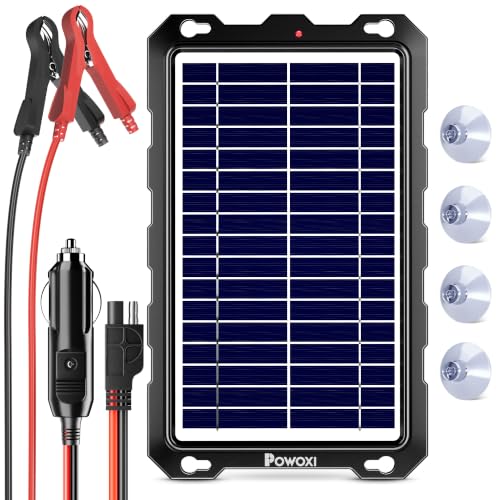
Upgrade Intelligent Charge Controller: Built-in internal protection system and smart fast charging Cooperate with Quality solar silicon material ensures high conversion and stable output the solar panel's energy conversion efficiency to 25-30%
Ideal Wattage
For a 40Ah battery, targeting an ideal wattage optimizes charging. Typically, a 100 to 150-watt solar panel suffices for daily charging needs, depending on your energy consumption. For instance, if your 40Ah battery operates at 12 volts, its capacity in watt-hours is approximately 480Wh (40Ah × 12V). If you anticipate using around 600Wh daily, a 150-watt solar panel provides overhead for cloudy days and system inefficiencies.
| Solar Panel Wattage | 40Ah Battery Capacity (Wh) | Estimated Daily Energy Needs (Wh) |
|---|---|---|
| 100 watts | 480 | 400 |
| 150 watts | 480 | 600 |
Efficiency Considerations
Efficiency affects how effectively solar panels charge your 40Ah battery. Various factors influence panel efficiency:
- Sunlight Hours: Estimate daily average sunlight hours (5-7 hours in optimal conditions). More sunlight leads to better energy generation.
- Panel Type: Monocrystalline panels offer higher efficiency (15-22%) compared to polycrystalline (13-16%) and thin-film panels (10-12%). Selecting a more efficient panel reduces space requirements and maximizes energy capture.
- Angle and Orientation: Proper positioning maximizes sunlight exposure. Adjust the panel angle based on your geographic location to capture the most sunlight.
- System Losses: Factor in losses from cables, controllers, or inverters. System losses typically range from 10-20%, meaning a 150-watt panel may only provide around 120-135 watts to the battery.
Taking these efficiencies into account ensures you choose a solar panel that meets your battery charging needs effectively. Assess these points carefully to optimize your overall solar energy system.
Installation and Setup
Setting up your solar panels for charging a 40Ah battery requires careful planning and execution. Proper installation ensures efficient energy capture and optimal battery performance.
Mounting Options
Consider various mounting options for your solar panels.
- Roof Mounts: Ideal for RVs and boats, roof mounts provide a stable base with good sun exposure. Ensure the roof can support the weight and angle of the panels effectively.
- Ground Mounts: Ground mounts offer flexibility in positioning. Choose a location that receives maximum sunlight and is free from obstructions like trees or buildings.
- Portable Mounts: If you prefer flexibility, consider portable mounts. These setups allow you to adjust panel orientation based on sunlight, enhancing charging efficiency.
Select the mounting method that best suits your setup. Secure all components firmly to withstand wind and other environmental factors.
Connecting Solar Panels to the Battery
Connecting your solar panels to the battery involves a few straightforward steps.
- Gather Materials: You’ll need solar panels, wiring, a charge controller, and connectors. Ensure they match the specifications of your battery system.
- Install the Charge Controller: Attach the charge controller between the solar panels and the battery. This device regulates voltage and current, preventing overcharging.
- Connect the positive output from the solar panels to the positive terminal on the charge controller.
- Connect the negative output from the solar panels to the negative terminal on the charge controller.
- Connect to the Battery:
- Connect the positive output from the charge controller to the positive terminal on the battery.
- Connect the negative output from the charge controller to the negative terminal on the battery.
- Check Connections: Ensure all connections are secure and insulated to prevent shorts.
- Monitor Performance: Keep an eye on the charge controller to monitor battery charging status. This helps in identifying any issues early.
By following these steps, you can efficiently connect your solar panels to a 40Ah battery, ensuring effective charging and performance.
Conclusion
Choosing the right size solar panel for your 40Ah battery can make all the difference in your off-grid adventures. By understanding your energy needs and considering factors like sunlight availability and panel efficiency you can ensure a smooth charging process.
Whether you go for a 100 or 150-watt panel it’s crucial to have a little extra capacity to handle those cloudy days. With the right setup and careful planning you’ll be well on your way to harnessing the power of the sun and keeping your battery charged and ready for action. Enjoy your solar journey and the freedom it brings!
Frequently Asked Questions
What is a 40Ah battery used for?
A 40Ah battery is commonly used in RVs, boats, and off-grid setups. It offers a versatile power solution for running appliances, lights, and other electronic devices in situations where conventional power sources are unavailable.
How do I choose the right solar panels for charging a 40Ah battery?
To choose the right solar panels, consider factors like battery voltage, daily energy requirements, average sunlight hours, and panel efficiency. Generally, a panel size of 100 to 150 watts is recommended to meet daily charging needs effectively.
What types of 40Ah batteries are available?
There are two main types of 40Ah batteries: lead-acid and lithium-ion. Lead-acid batteries are cost-effective and reliable but should not be discharged below 50%. In contrast, lithium-ion batteries are lightweight, have a longer lifespan, and can be discharged almost completely.
How do solar panels charge a 40Ah battery?
Solar panels convert sunlight into direct current (DC) electricity using solar cells made of semiconductor materials. This DC electricity can charge a 40Ah battery directly, making solar power an efficient option for renewable energy sources in off-grid scenarios.
How do I calculate the solar panel wattage needed for a 40Ah battery?
To calculate the required solar panel wattage, determine your daily energy needs in watt-hours, adjust for system losses, and factor in average sunlight hours. For example, a setup to supply 600Wh daily would need approximately 150 watts of solar panels.
What are the best mounting options for solar panels?
The best mounting options include roof mounts for RVs and boats, ground mounts for flexibility, and portable mounts for adjustable orientation to capture sunlight effectively. Proper mounting ensures optimal solar panel performance and energy collection.
How can I monitor the charging status of my battery?
To monitor charging status, use a charge controller connected to your solar panel and battery system. A charge controller tracks the battery’s charge level and prevents overcharging, ensuring effective and safe battery performance.
