

Ever wondered how many solar panels you need to charge your battery effectively? It’s a common question for anyone looking to harness the power of the sun. You might be considering solar energy for your home, RV, or even a camping trip, and figuring out the right setup can be tricky.
Imagine you’re ready to power your devices off-grid, but you’re unsure if your solar panels will do the job. This article will guide you through the essentials of calculating the solar panel capacity needed to keep your battery charged. By the end, you’ll have a clearer understanding of your energy needs and how to meet them efficiently.
Key Takeaways
- Solar Panel Types: Understand the two main types of solar panels—monocrystalline (high efficiency) and polycrystalline (cost-effective)—to select the best option for your energy needs.
- Battery Types: Familiarize yourself with different battery types (lead-acid, lithium-ion, nickel-cadmium) to determine which one suits your solar energy system based on efficiency, cost, and maintenance.
- Charging Factors: Several factors affect battery charging time, including battery capacity, solar panel output, sunlight availability, and the efficiency of the charge controller.
- Calculating Requirements: Assess daily energy consumption and depth of discharge to accurately calculate the number of solar panels needed. Ensure panel wattage aligns with your energy needs and available sunlight hours.
- Practical Examples: Apply real-world scenarios to determine solar panel requirements for both small (100Ah) and large (400Ah) battery systems, taking into account daily energy usage and panel efficiency.
- Optimization: Factor in panel orientation and use charge controllers to maximize sunlight exposure and ensure optimal battery charging performance.
Understanding Solar Panels
Solar panels are vital for harnessing renewable energy from the sun. Understanding their components and functionality helps you determine how many panels you need to charge your battery effectively.
What Are Solar Panels?
Solar panels consist of photovoltaic (PV) cells that convert sunlight into electricity. These panels typically come in two types: monocrystalline and polycrystalline. Monocrystalline panels are made from single silicon crystal structures and offer higher efficiency. Polycrystalline panels, made from multiple silicon crystals, are usually less expensive but slightly less efficient.
How Do Solar Panels Work?
Solar panels work through a straightforward process. When sunlight hits the PV cells, it excites electrons, generating direct current (DC) electricity. This DC electricity can then charge a battery or power devices directly.
To maximize efficiency, consider a charge controller, which regulates the flow of electricity to the battery, preventing overcharging. Moreover, panel orientation and angle play a crucial role in maximizing sunlight exposure. For instance, tilt your panels 30 degrees towards the sun for optimal performance.
Understanding these factors ensures you charge your battery properly and utilize solar energy effectively.
Battery Charging Basics
Understanding how to charge batteries effectively with solar panels is crucial for maximizing your energy system’s efficiency. Proper knowledge of battery types and the factors affecting charging time ensures you get the most out of your solar setup.
Types of Batteries
You’ll primarily encounter three types of batteries when using solar panels:
- Lead-Acid Batteries: Commonly used for solar storage, lead-acid batteries are cost-effective and reliable. They come in two subtypes: flooded and sealed (AGM or gel). Flooded batteries require regular maintenance, while sealed types don’t.
- Lithium-Ion Batteries: These are more efficient and lighter than lead-acid batteries. Lithium-ion batteries offer deeper cycles and longer lifespans but come at a higher upfront cost. Their fast charging capability makes them an appealing choice for solar applications.
- Nickel-Cadmium Batteries: While not as common for solar systems due to their environmental concerns, nickel-cadmium batteries provide good performance in extreme temperatures. They tolerate deep discharges but come with a higher maintenance requirement.
Factors Affecting Charging Time
Multiple factors influence the time it takes to charge a battery with solar panels:
- Battery Capacity: A battery with a larger capacity (measured in amp-hours, or Ah) takes longer to charge. For example, a 100Ah battery will require more time than a 50Ah battery under the same solar conditions.
- Solar Panel Output: Higher wattage panels produce more energy. For instance, a 300W solar panel under optimal sunlight can charge a battery faster than a 100W panel.
- Sunlight Availability: Geographic location and seasonal changes affect sunlight exposure. Clear, sunny days yield quicker charging times compared to overcast or rainy days.
- Charge Controller Efficiency: Using a quality charge controller ensures optimal energy transfer from the panels to the battery, affecting overall charging speed. Look for MPPT (Maximum Power Point Tracking) controllers for higher efficiency.
- Battery State of Charge: A deeply discharged battery charges slower in its initial stages compared to one that’s partially charged.
With this knowledge, you can better assess how much solar panel capacity is necessary to effectively charge your chosen batteries.
Calculating Solar Panel Requirements
To charge a battery efficiently, knowing how to calculate the right solar panel requirements is essential. This involves understanding both battery capacity and solar panel output.
Recommended Products

【High Conversion Rate】This 20W solar panel with monocrystalline A+ solar cell has an excellent cell efficiency of 21%-30%. Designed to charge and maintain 12V rechargeable batteries like LiFePO₄, Lithium Ion, AGM, SLA, GEL, EFB, MF, etc. Keep batteries in charged for trailer, tractor, truck, boat, motorcycle, RV, car, lawn mower, water pump, gate opener, electric fence, etc
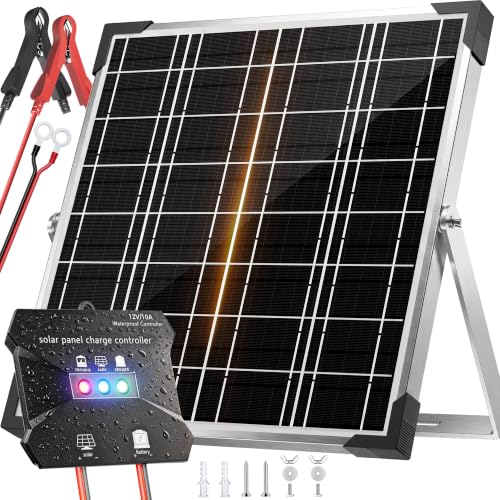
High-Efficiency MPPT Solar Charger - Advanced tracking technology delivers 20-30% faster charging for 12V batteries. A+ monocrystalline panels maximize power conversion. Perfect 20W solar trickle charger for cars, RVs, boats, and trailers. More sun captured, less time waiting.

Multiple Compatibility:Perfect solar power kit for variety of off grid applications like shed, cabin, gate opener, etc where 12V batteries is used, as well as to charge and maintain AGM, Flooded, GEL, Deep Cycle and Seal Lead Acid, etc batteries in car, Rv, boat, marine, trailer, camper, pump etc.
Battery Capacity and Size
Battery capacity directly affects how much energy you need from solar panels. Measured in amp-hours (Ah), battery capacity determines how long the battery can power devices before needing a recharge. For example, a 100Ah battery can supply 100 amps for one hour or 10 amps for ten hours.
To find out your needs, consider:
- Daily Energy Consumption: Assess the total daily watt-hours consumed by your devices. If devices use 300 watt-hours daily, you’d require a battery that can store at least that amount.
- Depth of Discharge (DoD): Different batteries have varying DoDs. For example, lead-acid batteries typically allow only 50% discharge, while lithium-ion batteries permit up to 80-90%. Adjust your capacity calculations accordingly.
- Size Considerations: Ensure your battery is appropriately sized for your energy needs while considering weight and space constraints.
Solar Panel Output and Efficiency
Solar panel output determines how much energy your panels generate. Output is measured in watts. Consider the panel’s wattage and sunlight availability to calculate the total energy generated.
Evaluation factors include:
- Solar Panel Wattage: Choose panels ranging from 100W to 400W. For instance, if you select a 300W panel, it can produce about 1,500 watt-hours (300W x 5 hours of sunlight) daily.
- Sunlight Hours: Assess your location’s average sunlight hours. While some regions may receive 5 hours of effective sunlight, others may receive less. Adjust your calculations based on these hours.
- Panel Efficiency: Higher efficiency panels generate more energy in limited space. Monocrystalline panels generally boast better efficiency than polycrystalline options.
By evaluating battery capacity and solar panel output, you can accurately determine how many solar panels your setup needs to keep your batteries charged efficiently.
Practical Examples
Understanding how many solar panels are needed to charge batteries depends on various factors, including battery size, daily energy usage, and solar panel output. Here are practical examples for both small and large battery systems.
Small Battery Systems
For a small battery system, consider a scenario with a 100Ah lead-acid battery. You typically discharge this battery to 50% for longevity, giving you 50Ah of usable capacity. If your daily energy consumption is 25Ah, you’ll need to replenish this amount each day.
Assuming you live in an area with an average of 5 sunlight hours per day, let’s calculate the required solar panel wattage:
- Daily Energy Needs: 25Ah
- Battery Voltage: 12V (common for small systems)
- Daily Energy in Watt-Hours: 25Ah × 12V = 300Wh
To find the total solar panel wattage needed:
- Wattage Required: 300Wh ÷ 5 hours = 60W
Thus, a single 100W solar panel suffices to charge the battery adequately, providing some buffer for inefficiencies and cloudy days.
Large Battery Systems
In a large battery system example, let’s look at a 400Ah lithium-ion battery. You’ll aim to keep the battery charged near 100%. If your daily energy usage amounts to 80Ah, the calculations change accordingly.
With the same assumption of 5 sunlight hours per day:
- Daily Energy Needs: 80Ah
- Battery Voltage: 48V (typical for larger systems)
- Daily Energy in Watt-Hours: 80Ah × 48V = 3840Wh
To determine the necessary solar panel wattage:
- Wattage Required: 3840Wh ÷ 5 hours = 768W
For this scenario, installing two 400W solar panels will efficiently cover your energy needs while accounting for system losses and variations in sunlight availability.
These examples illustrate how to calculate solar panel requirements for different battery systems effectively. By understanding your unique energy consumption and the specifics of your solar equipment, you can ensure reliable charging and optimal performance.
Conclusion
Finding the right number of solar panels to charge your battery doesn’t have to be overwhelming. By understanding your energy needs and the specifics of your battery system you can make informed decisions.
Keep in mind the type of battery you’re using and the average sunlight hours in your area. With the right calculations and setup you can ensure your batteries stay charged and ready for use.
Embracing solar energy can lead to a more sustainable lifestyle and greater energy independence. So take the plunge and enjoy the benefits of harnessing the sun’s power!
Frequently Asked Questions
How many solar panels do I need to charge a battery?
To determine the number of solar panels needed, consider your battery’s capacity in amp-hours (Ah) and daily energy consumption. For example, a 100Ah lead-acid battery may require one 100W solar panel, while a larger 400Ah lithium-ion battery could need two 400W panels.
What types of batteries are best for solar systems?
Three main types of batteries are commonly used with solar panels: lead-acid (cost-effective but requires maintenance), lithium-ion (more efficient and longer lifespan), and nickel-cadmium (performs well in extreme temperatures). Each has its advantages, depending on your needs.
How do solar panels work?
Solar panels convert sunlight into electricity using photovoltaic (PV) cells. When sunlight hits these cells, it excites electrons, generating direct current (DC) electricity, which can be stored in batteries or used directly.
What factors affect battery charging time?
Charging time is influenced by several factors: battery capacity, solar panel output, sunlight availability, efficiency of the charge controller, and the current state of charge of the battery.
How can I optimize my solar panel setup?
To optimize your setup, use a charge controller to regulate the flow of electricity, ensure your panels are oriented correctly for maximum sunlight exposure, and select panels with higher efficiency ratings.
What is the depth of discharge (DoD)?
Depth of Discharge (DoD) refers to the percentage of battery capacity that has been used. Maintaining an appropriate DoD is crucial for battery longevity, especially for lead-acid batteries, which typically have a recommended DoD of 50%.
Can I use solar panels for RVs or camping?
Yes, solar panels are an excellent option for RVs and camping as they provide a renewable energy source to charge batteries while off-grid, ensuring that your devices have power whenever you need them.
What is the average efficiency of solar panels?
The average efficiency of solar panels varies but typically ranges from 15% to 22%. Monocrystalline panels generally offer higher efficiency than polycrystalline panels, making them a better option for limited space installations.
