

Are you thinking about going solar and wondering how many panels you’ll need to charge your battery? You’re not alone. Many people are making the switch to renewable energy, but figuring out the right number of solar panels can feel overwhelming.
Imagine you’re ready to harness the sun’s power, but you’re unsure how to set everything up. This article will help you understand the factors that influence how many solar panels you need. You’ll learn about battery capacity, sunlight availability, and more. By the end, you’ll have a clearer picture of what it takes to keep your battery charged and your energy needs met.
Key Takeaways
- Understand Solar Panel Types: Familiarize yourself with the efficiency and characteristics of monocrystalline, polycrystalline, thin-film panels, and their suitability for different applications.
- Calculate Energy Needs: Assess your daily energy consumption by listing appliances and their wattages to determine how much energy you need from your solar panels.
- Evaluate Battery Capacity: Determine battery capacity in amp-hours (Ah) and ensure your solar panels can produce enough energy to charge the battery and cover your energy needs.
- Consider Efficiency Factors: Recognize how location, sunlight exposure, angle, and orientation of solar panels impact energy production and efficiency.
- Perform Basic Calculations: Use the simple formula to calculate the number of solar panels required: Daily Energy Needs (Wh) divided by Daily Panel Output (Wh).
- Plan for Future Needs: Keep in mind to factor in efficiency losses and possible future increases in energy consumption when sizing your solar panel system.
Understanding Solar Panels and Batteries
Solar panels convert sunlight into electricity, making them essential for charging batteries. Batteries store this energy for later use. Understanding the different types of solar panels and batteries helps in determining the right setup for your needs.
Recommended Products
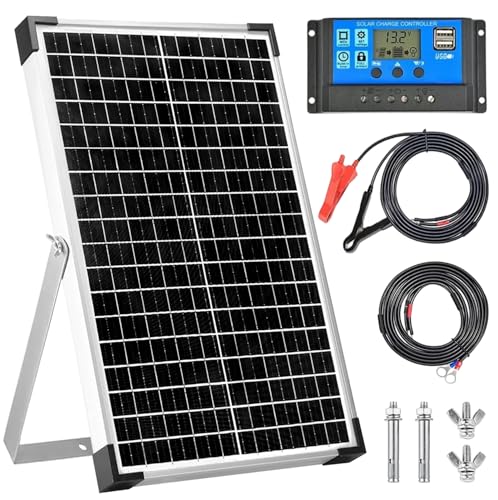
High-Efficiency Monocrystalline Solar Cells, Made of premium monocrystalline silicon, this 30W solar panel offers a 30% higher conversion efficiency than ordinary panels. The durable construction features a corrosion-resistant aluminum frame, tempered glass, and EVA/TPT backing for long-lasting performance in all weather.
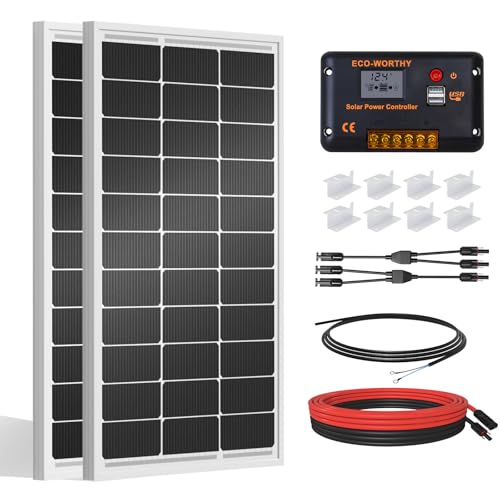
[Wide Application]: Daily Output 800wh/day under 4 hours full sunshine condition. Perfect for RV, Caravan, Marine, Camper, Electric scooter, Golf Carts, Power wheels, Trolling motor, Tool trailer, Backup power supply for cabin shed home etc.

High-Efficiency Monocrystalline Silicon: The 100W solar panel uses premium monocrystalline silicon cells, providing up to 30% higher efficiency than ordinary silicon, ensuring maximum power output even in low-light environments
Types of Solar Panels
- Monocrystalline Panels
Monocrystalline panels are made from single-crystal silicon. They offer high efficiency, typically around 15-22%. These panels perform better in low-light conditions and take up less space. - Polycrystalline Panels
Polycrystalline panels consist of multiple silicon crystals, leading to a slightly lower efficiency, ranging from 13-16%. These panels are usually more affordable but require more space to generate the same amount of energy as monocrystalline panels. - Thin-Film Panels
Thin-film panels are lightweight and flexible. Their efficiency is lower, often between 10-12%. However, they perform well in high temperatures and shading conditions. These panels are suitable for specific applications where other types may not fit.
- Lead-Acid Batteries
Lead-acid batteries are traditional, often used for solar setups. They are affordable and reliable but have a shorter lifespan (3-5 years) and lower energy density. They require regular maintenance. - Lithium-Ion Batteries
Lithium-ion batteries offer higher energy density, longer lifespan (up to 15 years), and lower maintenance. They are more expensive upfront, but their efficiency and longevity can justify the cost in the long run. - Nickel-Cadmium Batteries
Nickel-cadmium batteries are robust and can handle extreme temperature ranges. They have a long lifespan but suffer from memory effect, which affects capacity. They are less common for solar applications due to cost concerns. - Flow Batteries
Flow batteries store energy in liquid electrolytes, allowing for scalable energy capacity. They are still developing but show promise for long-duration storage, making them useful in larger solar systems.
Understanding these types helps in making informed decisions about your solar energy system, ensuring you select the right components for effective energy storage and usage.
Calculating Power Needs
Understanding how to calculate your power needs is vital for determining the number of solar panels necessary to charge a battery efficiently. By evaluating your energy requirements and battery capacity, you can create a reliable solar system.
Determining Your Energy Requirements
Start by assessing your daily energy consumption. List all the appliances you plan to power and their wattages. Then, calculate the total watt-hours used per day. For example, if you use a 60-watt bulb for 5 hours, that bulb consumes 300 watt-hours (60 watts x 5 hours). Repeat this for all devices and add them up. This total represents the energy you need to produce daily with your solar system.
Understanding Battery Capacity
Battery capacity is a crucial factor in determining how long your stored energy lasts. Measured in amp-hours (Ah), battery capacity indicates how much energy a battery can store. For instance, a 100 Ah battery can provide 100 amps for one hour or 10 amps for ten hours. When charging a battery, you need to ensure that your solar panels can supply enough energy to both charge the battery and meet your energy requirements.
To find the right battery for your needs, consider using the formula:
Total Daily Energy Needs (in watt-hours) / Battery Voltage = Required Capacity (in amp-hours)
If you need 1,200 watt-hours and use a 12-volt battery, the calculation would look like this:
1,200 watt-hours / 12 volts = 100 amp-hours
This calculation shows that you’d need a 100 Ah battery to meet your energy needs. Make sure to factor in efficiency losses during charging to avoid underestimating the capacity needed. This approach ensures you choose the right components for your solar energy system.
Factors Affecting Solar Panel Efficiency
Several factors influence the efficiency of solar panels. Understanding these aspects helps optimize energy production and battery charging.
Location and Sunlight Exposure
Location plays a crucial role in solar panel efficiency. Areas with abundant sunlight generate more energy. Consider local climate patterns, including seasonal variation and average sunny days per year. For instance, if you live in Arizona, expect higher energy production than in regions like Washington, which has more cloudy days.
Sunlight exposure also depends on obstructions like trees or buildings that cast shadows. If possible, position your solar panels away from these barriers for maximum sunlight access. Measuring sun exposure using tools like solar pathfinders can help determine the best placement for your panels throughout the day.
Angle and Orientation of Panels
The angle and orientation of solar panels significantly affect energy production. Ideally, panels should face true south for maximum exposure in the Northern Hemisphere. In the Southern Hemisphere, panels should face true north.
Adjusting the tilt angle of your solar panels based on seasonal sun paths enhances efficiency. An optimal angle for fixed panels ranges from 30° to 45°. Utilize a solar angle calculator to find the best tilt for your specific geographic location. Additionally, consider using tracking systems for dynamic adjustment throughout the day, which can capture up to 25% more sunlight than stationary panels.
By considering these factors, you can enhance the efficiency of solar panels and ensure sufficient energy to charge your batteries effectively.
How Many Solar Panels to Charge a Battery
Determining how many solar panels you need to charge a battery involves a few calculations. You’ll consider battery capacity, daily energy needs, and solar panel output.
Basic Calculation Formula
To determine the number of solar panels necessary, use this simple formula:
- Calculate Daily Energy Needs: Sum the watt-hours (Wh) for all devices you’ll be using per day. For example, if your appliances consume 1,500 Wh daily, that’s your baseline.
- Find Battery Capacity: Know your battery’s capacity in amp-hours (Ah). For instance, a 100 Ah battery at 12 volts provides 1,200 Wh (100 Ah × 12V).
- Estimate Solar Panel Output: Find out the output of your solar panels. If each panel offers 300 watts and receives five hours of sunlight daily, that panel generates 1,500 Wh (300W × 5h).
- Calculate Required Solar Panels: Divide your daily energy needs by the energy produced by one solar panel per day. Using the previous example:
- Daily energy needs: 1,500 Wh
- Panel output: 1,500 Wh per panel
This means you need one solar panel to meet your energy requirements.
- Scenario 1: You need 3,000 Wh daily, your battery has a 150 Ah capacity (1,800 Wh), and each 300W panel produces 1,500 Wh daily.
Calculation: - Daily energy needs: 3,000 Wh
- Panel output: 1,500 Wh
- Required panels: 3,000 Wh ÷ 1,500 Wh/panel = 2 panels
- Scenario 2: Your energy requirement is 4,200 Wh, with a 200 Ah battery (2,400 Wh), and each panel again produces 1,500 Wh.
Calculation: - Daily energy needs: 4,200 Wh
- Panel output: 1,500 Wh
- Required panels: 4,200 Wh ÷ 1,500 Wh/panel = 2.8 panels (round up to 3 panels)
By applying these calculations and scenarios, you can determine the precise number of solar panels needed to effectively charge your battery and meet your energy demands.
Conclusion
Finding the right number of solar panels to charge your battery doesn’t have to be overwhelming. By understanding your energy needs and considering factors like battery capacity and sunlight exposure, you can make informed decisions.
Remember to take into account the type of solar panels and batteries that suit your lifestyle. With a little planning and the right calculations, you’ll be well on your way to harnessing solar energy efficiently.
Embrace the journey toward sustainable energy and enjoy the benefits of going solar. Your future self will thank you for it!
Frequently Asked Questions
How do I determine the number of solar panels needed to charge a battery?
To determine the number of solar panels required, first assess your daily energy consumption in watt-hours. Next, calculate the battery’s capacity in amp-hours. Use the formula: Total watt-hours ÷ (solar panel output per hour × sunlight hours) to get the number of panels needed.
What factors influence the efficiency of solar panels?
Several factors affect solar panel efficiency, including location, the amount of sunlight exposure, temperature, and panel orientation. Panels should be positioned away from obstructions and ideally face true south (in the Northern Hemisphere) to maximize sunlight absorption.
What types of solar panels are available?
The three main types of solar panels are monocrystalline, polycrystalline, and thin-film. Monocrystalline panels are highly efficient and space-saving but usually more expensive. Polycrystalline panels offer good efficiency at a lower cost, while thin-film panels are lightweight and flexible but tend to be less efficient.
What should I consider when choosing a battery for solar energy?
Key considerations for selecting a battery include capacity (measured in amp-hours), lifespan, maintenance requirements, and compatibility with solar systems. Common options include lead-acid, lithium-ion, and nickel-cadmium batteries, each with distinct characteristics suited for different needs.
How can I calculate my daily energy consumption?
To calculate daily energy consumption, list your household appliances and note their wattages. Multiply each appliance’s wattage by the number of hours used daily, then add up these totals to get your total watt-hours consumed per day.
What is the significance of panel tilt and orientation?
The angle and orientation of solar panels are crucial for optimal energy capture. Panels should be adjusted to face true south in the Northern Hemisphere and true north in the Southern Hemisphere. The tilt angle may also need to change seasonally based on the sun’s path.
What steps can I take to maximize solar panel output?
To maximize solar panel output, ensure panels are free from obstructions, oriented correctly, and adjusted for optimal tilt based on seasons. Regularly clean the panels and consider using tracking systems to follow the sun’s movement for additional energy capture.
Can I use solar power for all my household needs?
Yes, solar power can be used for all household energy needs, provided the solar panel and battery system are designed to meet your specific energy requirements. Ensure you properly calculate your daily consumption and select adequate system components to support your needs.
