

Are you planning a road trip in your RV and wondering how to keep your battery charged? You’re not alone. Many RV enthusiasts face the challenge of finding the right solar panel wattage to ensure their batteries stay powered during their adventures.
Key Takeaways
- Understand Battery Requirements: Knowing battery types and capacities is crucial to determine the right solar panel wattage for efficient charging while RVing.
- Calculate Daily Energy Needs: Assess daily energy consumption of appliances to estimate the required amp-hours and select an appropriate solar panel wattage.
- Consider Sunlight Availability: Factor in usable sunlight hours, typically 4 to 6 hours per day, which significantly influences solar panel wattage needs.
- Choose the Right Panel Type: Opt between monocrystalline and polycrystalline panels based on efficiency, space, lifespan, and budget to maximize solar charging effectiveness.
- Select Essential Components: Invest in a quality solar charge controller, compatible batteries, proper wiring, and secure mounting hardware to ensure optimal system performance.
- Regular Maintenance and Monitoring: Periodically inspect and maintain your solar charging system, and monitor performance to ensure consistent energy supply for your RV adventures.
Understanding RV Battery Requirements
Understanding RV battery requirements helps you choose the right solar panel wattage for effective charging. Key factors include battery types, capacity, and your energy consumption patterns.
Types of RV Batteries
You’ll find three primary types of RV batteries:
- Lead-Acid Batteries: Common and cost-effective, these batteries come in two variations—flooded and sealed. Flooded batteries need regular maintenance, while sealed batteries require less attention but can be pricier.
- Lithium Batteries: Known for longevity and depth of discharge, lithium batteries charge faster and last longer than lead-acid options, though at a higher initial cost.
- AGM Batteries: Absorbent Glass Mat batteries provide a good mix of performance and safety. They don’t need maintenance and can handle deep discharges, making them versatile for RV use.
Battery Capacity and Usage
Battery capacity, measured in amp-hours (Ah), determines how long your RV battery can run appliances before needing a recharge. To calculate your battery needs, consider:
- Daily Energy Consumption: List the appliances you use, their wattage, and the hours you operate each.
- Required Battery Capacity: Multiply total daily watt-hours by your desired battery runtime to find the amp-hour requirement. For example, if you use 300 watt-hours daily, you’ll need a battery with at least 25 Ah capacity (300 watt-hours / 12 volts).
Understanding your battery’s capacity and your usage patterns ensures that you select a solar panel system capable of meeting your energy needs while on the road.
Determining Solar Panel Wattage
Understanding the right solar panel wattage ensures efficient charging of your RV battery. Several factors influence this calculation, including battery type, energy consumption, and available sunlight.
Recommended Products
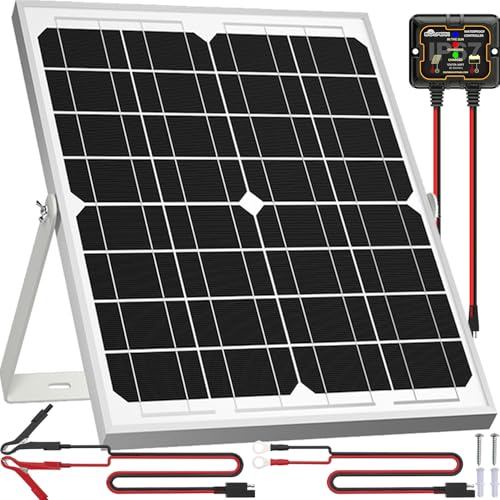
【High Conversion Rate】This 20W solar panel with monocrystalline A+ solar cell has an excellent cell efficiency of 21%-30%. Designed to charge and maintain 12V rechargeable batteries like LiFePO₄, Lithium Ion, AGM, SLA, GEL, EFB, MF, etc. Keep batteries in charged for trailer, tractor, truck, boat, motorcycle, RV, car, lawn mower, water pump, gate opener, electric fence, etc
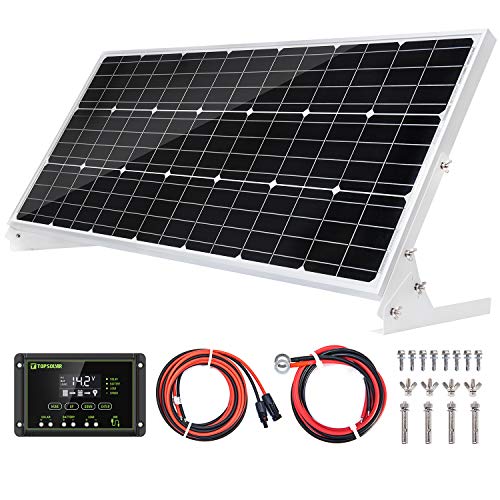
Perfect for off grid 12 volt batteries charging system and a variety of DC applications, designed for charging 12 volt batteries in car, RVs, cabins, boats, marines, shed, cabin, gate opener, battery operated gates, dry camping, garden watering, work great for back-up power and remote power use.

【High-Efficiency MPPT Controller】This advanced MPPT charge controller providing over 30% additional power compared to standard solar charge controllers. This fully waterproof MPPT controller can be completely submerged in water. It offers comprehensive protection for your battery, safeguarding against overcharging, deep discharging, excessive voltage, current surges, overloads, short circuits, reverse polarity, and overheating
Factors Influencing Wattage Calculation
- Battery Capacity: Battery capacity, measured in amp-hours (Ah), directly affects how much energy you need. Larger capacity batteries require more wattage.
- Daily Energy Use: Calculate your average daily energy consumption by tracking the usage of appliances, lights, and devices. Knowing this helps determine your energy needs and corresponding solar panel wattage.
- Sunlight Availability: The amount of sunlight your RV receives varies by location and season. On average, you can expect about 4 to 6 hours of usable sunlight per day in optimal conditions. This impacts how much wattage your solar setup needs.
- System Efficiency: Consider the efficiency of your solar setup. Losses occur in the charge controller and inverter, so factor roughly 25% loss when calculating wattage needs.
| Battery Type | Capacity (Ah) | Recommended Solar Panel Wattage |
|---|---|---|
| Lead-Acid | 100 | 100-200 watts |
| Lithium | 100 | 50-120 watts |
| AGM | 100 | 100-150 watts |
- Lead-Acid: These batteries typically require 100 to 200 watts of solar power for optimal charging, depending on your energy use and sunlight access.
- Lithium: For lithium batteries, 50 to 120 watts should suffice, as they charge more efficiently and can discharge deeper.
- AGM: AGM batteries often require 100 to 150 watts, striking a balance between lead-acid and lithium charging needs.
Selecting the right solar panel wattage based on these factors enhances your RV experience, providing reliable energy for your adventures on the road.
Solar Panel Options
Selecting the right solar panel type enhances your RV battery charging experience. Two primary types of solar panels exist: monocrystalline and polycrystalline. Each offers distinct advantages.
Recommended Products
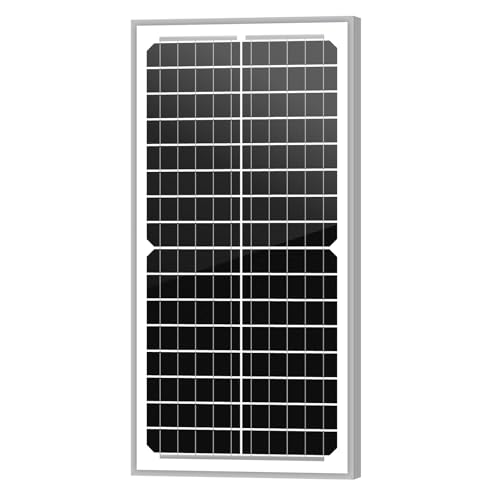
【New Design】High-performance mono cells encapsulated in EVA ensure excellent conversion rate up to 21-23%.

【Maximum Power】20W, voltage at Pmax (Vmp):19.08V, current at Pmax (Imp): 1.05A
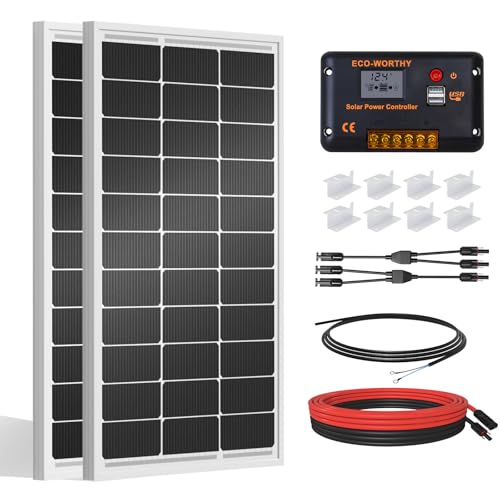
[Wide Application]: Daily Output 800wh/day under 4 hours full sunshine condition. Perfect for RV, Caravan, Marine, Camper, Electric scooter, Golf Carts, Power wheels, Trolling motor, Tool trailer, Backup power supply for cabin shed home etc.
Monocrystalline vs. Polycrystalline
- Monocrystalline Panels: Known for high efficiency, these panels convert sunlight into energy more effectively. They typically generate more power per square foot, making them ideal for limited space on an RV roof. Their lifespan often exceeds 25 years, providing reliable energy for trips.
- Polycrystalline Panels: Generally less efficient than monocrystalline panels, polycrystalline panels are more affordable. They come with a shorter lifespan, usually around 20 years. While they may require more space compared to monocrystalline, they still offer decent performance for casual RV users.
- Portable Solar Panels: These lightweight panels allow flexibility in placement. You can set them up in direct sunlight to maximize energy collection. Ideal for those who park in shaded areas frequently, portable panels can easily be transported and positioned as needed.
- Fixed Systems: Fixed solar panel systems mount directly onto your RV roof. They provide continuous charging while the vehicle is stationary or in motion. Although they don’t offer the same flexibility as portable panels, they require less effort for setup and ensure consistent energy generation.
Consider the specific needs of your RV lifestyle when choosing between these options. The right solar panel setup ensures that your battery stays charged, allowing you to enjoy every adventure.
Setting Up Your Solar Charging System
Setting up your solar charging system involves choosing the right components and following best installation practices to optimize battery charging for your RV.
Recommended Products
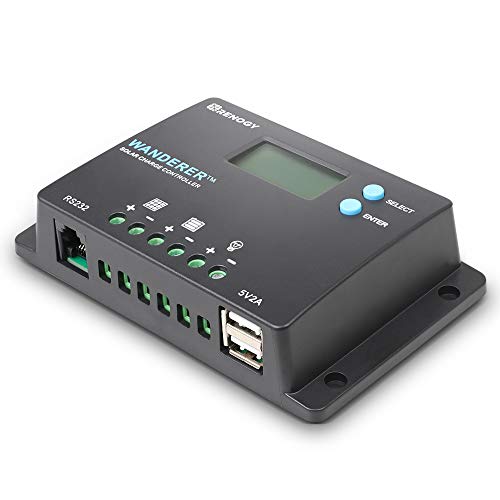
𝐒𝐦𝐚𝐫𝐭 𝟒-𝐒𝐭𝐚𝐠𝐞 12V/24V Solar Charge Controller: Renogy charge controller 𝐦𝐚𝐱𝐢𝐦𝐢𝐳𝐞𝐬 𝐁𝐚𝐭𝐭𝐞𝐫𝐲 𝐋𝐢𝐟𝐞 & 𝐒𝐨𝐥𝐚𝐫 𝐄𝐟𝐟𝐢𝐜𝐢𝐞𝐧𝐜𝐲, this advanced pwm solar charge controller utilizes intelligent 4-stage charging (Bulk/Boost/ Float/Equalization) to optimize power delivery for AGM, Gel, Flooded and Lithium batteries. RV solar charge controller prevents overcharging and gas buildup while 𝐚𝐜𝐡𝐢𝐞𝐯𝐢𝐧𝐠 𝟑𝟎% 𝐥𝐨𝐧𝐠𝐞𝐫 𝐛𝐚𝐭𝐭𝐞𝐫𝐲 𝐥𝐢𝐟𝐞𝐬𝐩𝐚𝐧 compared to basic charge controllers.

12V Universal Solar Charge Controller- Renogy Solar controller optimizes charging for 𝐋𝐢𝐭𝐡𝐢𝐮𝐦, 𝐀𝐆𝐌, 𝐆𝐞𝐥, & 𝐅𝐥𝐨𝐨𝐝𝐞𝐝 𝐛𝐚𝐭𝐭𝐞𝐫𝐢𝐞𝐬. Smart PWM solar panel controller technology auto-selects the perfect charging curve (𝐁𝐮𝐥𝐤/𝐁𝐨𝐨𝐬𝐭/ 𝐅𝐥𝐨𝐚𝐭/ 𝐄𝐪𝐮𝐚𝐥𝐢𝐳𝐚𝐭𝐢𝐨𝐧) for your RV, boat, or off-grid setup. Renewable energy controllers easily switch battery types and monitor real-time charging stages via intuitive LEDs, mmaximizing battery lifespan.
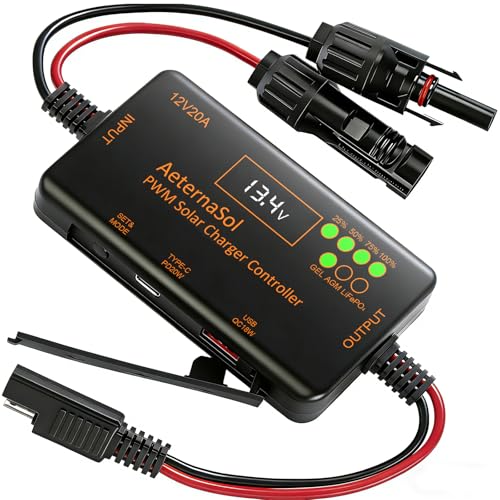
【Precise Compatibility + Upgraded 20APWM Charging: Efficiency Beyond Standard】 As the "core manager" of 12V solar systems, this controller is exclusively engineered for 12V batteries (NOT compatible with 24V/36V packs) and works seamlessly with all solar panels below 300W. Equipped with upgraded 20A PWM technology, it delivers double the current output compared to common 10A controllers, enabling faster and more stable battery charging. Optimized intelligent charging algorithms minimize energy loss by precisely regulating power flow from panels to batteries, while a critical note: no polarity converter is included—please ensure correct positive/negative connection to avoid equipment damage.
Essential Components of the System
- Solar Panels
Select panels based on wattage requirements. For lead-acid batteries, choose panels between 100 and 200 watts. For lithium batteries, opt for 50 to 120 watts. AGM batteries typically need 100 to 150 watts. - Charge Controller
Include a charge controller to regulate voltage and current from the solar panels. It prevents overcharging and prolongs battery life. MPPT controllers are more efficient than PWM controllers but usually cost more. - Batteries
Use batteries appropriate for your energy needs. Lithium batteries charge faster and have longer life spans but cost more upfront. Lead-acid batteries are less expensive but require more maintenance. - Wiring and Connectors
Use quality wiring and connectors to minimize energy loss. Opt for wiring gauges that support the amperage requirements of your system. Waterproof connectors protect against corrosion. - Mounting Hardware
Ensure secure mounting hardware for either fixed or portable panels. Use brackets designed for your panel type to prevent shifting and damage during travel.
- Choose the Right Location
Position solar panels to maximize sun exposure. Aim for a south-facing installation if you’re in the northern hemisphere. Avoid shaded areas from trees or other structures. - Ensure Proper Angling
Tilt solar panels at an angle that matches your latitude for maximum efficiency. This angle allows optimal sunlight capture, especially during winter months. - Check Compatibility
Verify that all components are compatible. Match the voltage of the solar panels with that of the batteries and the charge controller. - Regular Maintenance
Inspect your system regularly. Check connections for wear and corrosion, clean solar panels to remove dust, and monitor battery health to prevent issues. - Monitor Performance
Use a battery monitor to track charging status and usage. This tool helps you understand energy consumption patterns and adjust your solar setup as needed.
By carefully selecting components and following best practices, you can ensure a reliable solar charging system that keeps your RV batteries powered for all your adventures.
Conclusion
Choosing the right solar panel wattage for your RV battery is key to enjoying worry-free adventures. By understanding your battery type and daily energy needs you can easily determine the wattage that’ll keep you powered up on the road.
Whether you opt for monocrystalline or polycrystalline panels or even portable options each choice has its benefits. Remember to consider your specific lifestyle and how much energy you typically use.
With the right setup and a little maintenance you’ll be ready to hit the open road knowing your batteries are charged and your adventures await. Happy travels!
Frequently Asked Questions
What is the best way to keep RV batteries charged during road trips?
To keep RV batteries charged during road trips, consider installing a suitable solar panel system. Understand your battery type—lead-acid, lithium, or AGM—and calculate your daily energy needs to select the right wattage for solar panels. Regular maintenance and monitoring are also essential for optimal performance.
How do I determine the solar panel wattage I need for my RV battery?
The required solar panel wattage depends on your battery type and daily energy consumption. Generally, lead-acid batteries need 100 to 200 watts, lithium batteries require 50 to 120 watts, and AGM batteries need 100 to 150 watts. Assess your energy use to choose appropriately.
What are the different types of RV batteries?
The three main types of RV batteries are lead-acid, lithium, and AGM. Lead-acid batteries are affordable but less efficient, lithium batteries are lightweight and have a longer lifespan, while AGM batteries offer benefits of both but at a higher cost.
How can I calculate my daily energy needs for my RV?
Calculate your daily energy needs by identifying the wattage of all devices you plan to use and how many hours you’ll run each. Multiply the wattage by the hours to find total daily watt-hours. This will help you choose the right battery and solar panel system.
What are the pros and cons of monocrystalline vs. polycrystalline solar panels?
Monocrystalline panels are more efficient and have a longer lifespan, making them great for limited roof space. On the other hand, polycrystalline panels are more affordable but less efficient and have a shorter lifespan. Choose based on your budget and energy needs.
What components do I need for a solar charging system in my RV?
Essential components for a solar charging system include solar panels, charge controllers, batteries, wiring, connectors, and mounting hardware. Ensure all components are compatible and correctly installed for efficient energy collection and usage.
How should I position my solar panels for maximum efficiency?
Position your solar panels for maximum sun exposure by installing them on a flat roof or tilting them, if possible. Avoid shaded areas and regularly clean panels to ensure optimal sunlight intake.
What maintenance is required for my RV solar system?
Regular maintenance for your RV solar system includes inspecting wiring for damage, checking battery levels, cleaning solar panels, and ensuring all connections are secure. Monitor performance to catch any issues early, ensuring reliable charging for your adventures.
